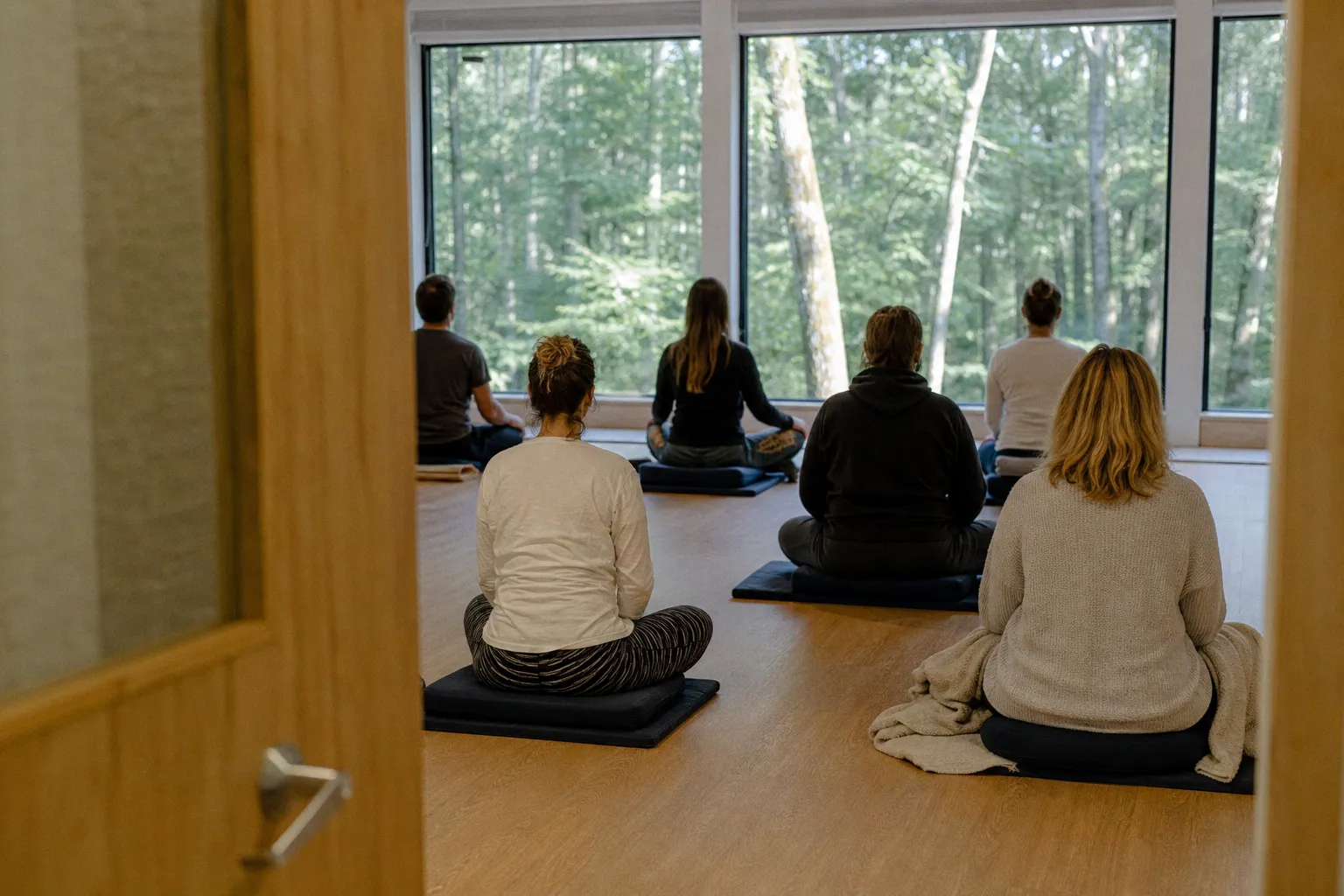
Overthinking rarely feels like “thinking too much” from the inside. It feels more urgent than that: the mind returning to the same conversation, the same possible mistake, the same unfinished decision, as if one more pass through the material will finally make us safe. We may be lying in bed, answering an email, washing a cup, or trying to listen to someone we love, while another part of the mind runs a private hearing with no verdict.
Mindfulness meditation for overthinking is not a promise that the mind will become blank. That promise is both unrealistic and, frankly, unkind. The mind produces thoughts; that is part of its work. What mindfulness offers is more subtle and more useful: a way to notice when we have been pulled into repetitive loops, anchor attention in the present moment, and slowly change our relationship with the thoughts that keep demanding the whole room.
The neuroscience of rumination: why the brain gets stuck
Rumination is not ordinary reflection. Reflection tends to move; rumination circles. It repeats the same emotional material without generating new information or a workable next step. We revisit what we said, what they meant, what might happen, what should have happened, and the nervous system behaves as though review itself is protection.
From a clinical point of view, this is one reason overthinking can feel so persuasive. The brain is trying to reduce uncertainty. It scans for threats, replays social pain, and rehearses possible futures. In small doses, this capacity helps us learn. In excess, it becomes a treadmill: high effort, low movement.
A key player here is the Default Mode Network, often shortened to DMN. This is a set of brain regions that becomes active when our attention is not focused on a specific external task. It is involved in self-referential thinking: remembering, imagining, evaluating ourselves, constructing narratives about who we are and what things mean. None of this is inherently a problem. We need a self-story. We need memory. We need the ability to imagine consequences.
The difficulty begins when the DMN becomes the room where we live rather than a room we can enter and leave. During excessive mind-wandering and overthinking, this network can become overactive, especially when thoughts are charged with worry, regret, shame, or anticipation. The mind is not simply “busy”; it is repeatedly building a self-focused story and then reacting to that story as if it were immediate reality.
The body often joins in. Stress physiology does not wait politely until we confirm that a danger is real. A predicted threat can be enough to increase tension, disturb sleep, alter breathing, and keep us watchful. Cortisol, one of the body’s primary stress hormones, is part of this system. When worry becomes habitual, the body can begin to carry the cost of imagined emergencies.
Overthinking is not a character flaw. It is a protective process that has lost its sense of proportion.
This distinction matters because we navigate overthinking more effectively when we stop treating it as a failure of willpower. If you could reason your way out of rumination by force, you likely would have done it already. Mindfulness works differently. It trains attention, awareness, and emotional regulation so that a thought can be recognized as a mental event rather than obeyed as an instruction.
Focused attention: how mindfulness trains the wandering mind
One of the simplest forms of meditation for racing thoughts is focused attention practice. We choose an anchor — often the breath, bodily sensation, or sound — and rest attention there. Then the mind wanders. We notice. We return.
That sequence may sound almost too modest, but it is the central training. The value is not in staying perfectly focused. The value is in the moment of noticing that attention has been captured, and in the gentle return that follows. Each return teaches the nervous system a different pattern: I do not have to follow every thought to its conclusion.
In overthinking, thoughts tend to arrive with a feeling of command. “Solve this now.” “Review that again.” “Prepare for every outcome.” Focused attention interrupts the automatic chain between thought and involvement. We are not fighting the thought. We are not replacing it with a slogan. We are practicing a small but powerful cognitive movement: seeing, naming, and returning.
A basic practice might look like this:
1. Settle the body before trying to settle the mind. Place both feet on the floor or let the body be supported by a chair, bed, or cushion. The posture does not need to be impressive; it needs to be sustainable.
2. Choose one clear anchor. The breath at the nostrils, the rise and fall of the chest, the contact of hands resting in the lap, or ambient sound can all work. We choose one, not because it is magical, but because the mind needs somewhere to return.
3. Notice the first pull into thought. It may be a sentence, image, planning sequence, memory, or body sensation wrapped in worry. The task is not to stop it. The task is to recognize, “thinking is happening.”
4. Name the pattern lightly. Words such as “planning,” “replaying,” “worrying,” or simply “thinking” can create enough space to prevent full absorption.
5. Return to the anchor without punishment. This is the practice. Not the failure of the practice. The return is where the training lives.
In clinical mindfulness traditions, this is often described as decentering: the ability to experience thoughts as events in the mind rather than as facts, commands, or definitions of the self. Mindfulness-Based Cognitive Therapy, or MBCT, uses this skill directly. It has been clinically shown to reduce relapse risk in people with recurrent depression, in part by helping them detach from ruminative thought cycles before those cycles deepen into mood states.
That does not mean mindfulness is a cure for depression or anxiety. It is not a replacement for therapy, medication when appropriate, social support, sleep, or safety. But as a complementary practice, it gives us a trainable way to interrupt one of the mind’s most painful habits: believing that repetitive thought is the same as useful thought.
What the evidence actually says — and what it does not
The science around mindfulness has grown quickly, and we do ourselves a favor by reading it with both hope and steadiness. The evidence is meaningful, but it is not a license for exaggerated promises.
A 2014 meta-analysis in JAMA Internal Medicine found moderate evidence that mindfulness meditation programs improve anxiety, depression, and pain, with effect sizes around 0.3. In plain language, that suggests real but not miraculous benefits. Mindfulness is not a switch. It is more like physical training for attention and emotional regulation: modest sessions, repeated consistently, can change capacity over time.
Mindfulness-Based Stress Reduction, or MBSR, was developed by Jon Kabat-Zinn in 1979 and is commonly structured as an eight-week program. This matters because much of the research on mindfulness is not based on a person trying one meditation once and feeling transformed. It is based on repeated practice, guided learning, and integration into daily life.
There is also evidence that mindfulness practice is associated with changes in the brain regions involved in stress response. Studies have found decreased gray matter density in the amygdala, a region strongly linked with threat detection and the “fight or flight” response. We should be careful not to reduce human suffering to one brain structure, yet the pattern is clinically meaningful: when people practice mindfulness consistently, the stress system can become less reactive.
Here is a grounded way to hold the evidence:
| What mindfulness appears to support | What that means in daily life | What we should not claim |
|---|---|---|
| Regulation of the Default Mode Network | Less automatic absorption in self-referential loops and worry stories | That the mind will stop producing thoughts |
| Reduced anxiety and depressive symptoms in some studies | More space between a trigger and a spiral | That mindfulness cures clinical anxiety or depression |
| Changes in stress-related brain regions such as the amygdala | A nervous system that may become less reactive over time | That every person will experience the same neural changes |
| Brief reductions in state anxiety after short practices | A 10–20 minute practice may help shift the immediate mental state | That one session resolves long-standing rumination |
| Decentering from thoughts | Thoughts feel more observable and less commanding | That painful thoughts become irrelevant or easy |
This measured interpretation is important because people who overthink are often already skilled at self-blame. If we present mindfulness as something that “should” calm you immediately, then a difficult session becomes one more piece of evidence in the mind’s case against itself. That is not therapy; that is pressure with softer lighting.
A more compassionate truth is this: some days meditation feels spacious, some days it feels crowded, and both can still be practice. The measure is not whether thoughts appeared. The measure is whether we noticed them with a little more clarity than before.
Brief interventions: why 10 minutes can matter
When the mind is racing, we often imagine that only a major life repair will help. Better work boundaries, better sleep, better relationships, fewer notifications, more certainty. Often, yes, the larger conditions matter. We should not pretend that breath awareness can compensate indefinitely for an impossible workload or chronic isolation.
And still, brief mindfulness exercises for overthinking can shift the immediate cognitive pattern. Research indicates that even short mindfulness interventions — sometimes in the range of 10 to 20 minutes — can reduce state anxiety and improve cognitive performance. That does not mean they erase the underlying issue. It means they can help the brain step out of escalation long enough to choose the next useful action.
This is where mindfulness becomes practical rather than decorative. We do not need to wait for a silent retreat, a perfect morning, or a mind that already feels calm. We can begin in the middle of ordinary friction: before opening a difficult message, after a tense meeting, while sitting in the car, or when we catch ourselves comparing, predicting, or replaying.
Modern life gives us many tiny rituals of checking. We check messages, numbers, replies, calendars, delivery times, and sometimes even the resale estimate of a device by looking at something as specific as battery health and trade-in value. There is nothing wrong with practical checking. The problem is when the same checking energy turns inward and becomes endless mental auditing: Did I sound strange? Did I choose correctly? What if I missed something?
A short mindfulness practice interrupts that audit by changing the task. Instead of answering every mental question, we anchor attention in a present-moment sensory experience. The nervous system receives a different signal: not all uncertainty requires immediate analysis.
Try this 12-minute structure when overthinking is active but not overwhelming:
1. Minutes 0–2: orient. Look around the room and name, silently, five neutral things you can see. Let the eyes land rather than scan. This helps the brain register current safety.
2. Minutes 2–5: feel contact. Notice where the body meets the chair, floor, bed, or ground. Let attention rest on pressure, temperature, and support. If thoughts intrude, label them “thinking” and return to contact.
3. Minutes 5–9: follow breathing without controlling it. Feel one inhale and one exhale at a time. If the breath feels uncomfortable, use the hands or feet as the anchor instead.
4. Minutes 9–11: name the loop. Ask gently, “What kind of thinking is here?” Planning, replaying, predicting, self-criticizing, comparing. Name the category, not every detail.
5. Minutes 11–12: choose one next action. Not a life solution. One action: drink water, write down the actual decision, send the necessary message, step outside, or go to bed without reopening the debate.
The last minute matters. Mindfulness is not meant to leave us floating in awareness while the same problem waits unchanged. It helps us distinguish between what needs action and what needs disengagement. Sometimes the next step is a practical repair. Sometimes it is rest. Sometimes it is admitting, “This is not solvable at 11:47 p.m.”
Guided meditation for overthinking: what to listen for
A guided meditation for overthinking can be especially helpful when the mind feels too loud to practice alone. The voice of a skilled guide serves as an external anchor. It reduces the burden of remembering what to do next, which is useful when working memory is already crowded with worry.
But not all guided practices are equally supportive. Some encourage a forced calm that can feel invalidating. Some imply that thoughts are intruders to be eliminated. For an overthinking mind, that framing often backfires. The more aggressively we try to push thoughts away, the more tightly we become entangled with them.
A useful guided meditation tends to include:
- Permission for thoughts to arise. This lowers the secondary struggle — the frustration about having thoughts in the first place.
- Clear, repeated anchors. Breath, sound, body contact, or sensation should be simple enough to return to without effortful analysis.
- Gentle labeling. Phrases like “noticing planning” or “recognizing worry” help us unravel the loop without entering its content.
- A steady pace. Too much talking can become another stream to process; too much silence can feel unstructured for beginners.
- A grounded ending. The practice should bring attention back to the body and the next moment, not leave us in a vague haze.
The aim is not to win an argument with the mind. The aim is to stop attending every argument it schedules.
If you are learning how to stop overthinking with mindfulness, it can help to rotate between guided and unguided practice. Guided sessions provide scaffolding. Unguided sessions build trust in your own capacity to notice and return. We are not trying to become dependent on a perfect meditation environment. We are building a skill that travels into meetings, kitchens, bedrooms, sidewalks, and difficult conversations.
Reframing the goal: thoughts are not the enemy
One of the most relieving shifts in mindfulness is realizing that thoughts do not need to disappear for us to be free from them. This is especially important for those of us who have spent years treating the mind like a courtroom: every thought submitted as evidence, every feeling cross-examined, every uncertainty treated as a case that must close before we can rest.
Mindfulness changes the frame. A thought can be present without becoming the center of our behavior. A worry can be noticed without being rehearsed. A memory can hurt without requiring another hour of analysis. This is not avoidance. Avoidance says, “I cannot bear to know this.” Mindfulness says, “I can know this is here without being consumed by it.”
In MBCT, people learn to recognize early warning signs of downward mood shifts and relate differently to the ruminative thinking that often accompanies them. That skill is not only relevant in recurrent depression. It is useful for many of us who know the texture of mental looping: the tightening, the narrowing, the sense that if we think harder we will finally become safe.
The more we practice, the more we can separate three layers that usually arrive tangled:
1. The trigger. A message not answered, a mistake, a tone of voice, an upcoming decision.
2. The story. “They are upset with me,” “I always ruin things,” “This will go badly,” “I should have known.”
3. The body response. Tight chest, shallow breath, agitation, heaviness, restless checking.
Mindfulness gives us a way to meet each layer without fusing them into one overwhelming truth. We can notice the trigger. We can name the story as a story. We can soothe the body response through grounding and breath. From there, action becomes cleaner. If an apology is needed, we can make one. If a plan is needed, we can write it. If the mind is simply replaying pain, we can choose not to feed the replay.
This is where the practice becomes deeply respectful of real life. We are not pretending problems are small. We are refusing to let rumination impersonate problem-solving.
Building a practice that survives ordinary life
The most effective mindfulness practice is usually the one we can actually repeat. For overthinking, consistency matters more than drama. Ten minutes done most days will often serve us better than an ambitious plan that collapses by Thursday.
A steady weekly rhythm might look like this:
| Situation | Practice | Why it helps |
|---|---|---|
| Morning mental rush | 10 minutes of breath or body-contact meditation before checking messages | Trains attention before the day’s inputs claim it |
| After a stressful interaction | 3 minutes of grounding through feet, hands, and exhale | Helps the nervous system discharge immediate activation |
| Midday decision fatigue | One minute of naming: “planning,” “worrying,” “comparing” | Separates useful thought from repetitive loops |
| Evening rumination | 12-minute guided meditation for overthinking | Provides structure when the mind is tired and sticky |
| Bedtime replay | Body scan from feet to head, without solving the day | Moves attention from narrative into sensation |
If sitting still increases distress, begin with mindful walking, gentle stretching, or a yoga-based practice that keeps attention connected to movement. For some nervous systems, especially those carrying trauma or high anxiety, stillness can initially feel exposing. That does not mean mindfulness is impossible. It means the doorway may need to be more embodied, shorter, and, if needed, supported by a therapist.
We also need to be honest about sleep. Overthinking and poor sleep feed each other with impressive efficiency. A tired brain has less cognitive control, more emotional reactivity, and a stronger tendency to treat thoughts as urgent. Mindfulness can help at night, but it works best alongside basic sleep hygiene: a consistent wind-down, less late-night stimulation, and a clear boundary around problem-solving in bed. The bed is a poor office for the anxious mind.
For many people, the most workable approach is to pair meditation with a written “parking place” for thoughts. Before practice, write down the concern in one sentence and, if relevant, the next action. Then meditate. This reassures the planning mind that we are not being careless. We are simply choosing not to rehearse the issue endlessly.
For example:
- “I need to ask for clarification about the deadline — send one message at 9 a.m.”
- “I am replaying the conversation with Maya — no action tonight; revisit tomorrow if it still feels important.”
- “I am worried about the appointment — write questions in the morning, then stop researching.”
This kind of structure respects the practical intelligence inside worry while refusing its demand for unlimited attention.
A grounded way to begin tonight
If overthinking has been your companion for a long time, please do not turn mindfulness into another performance you must get right. Begin smaller than your ambition. Begin in a way that lets your nervous system learn safety through repetition.
Tonight, try one micro-habit: when you notice the mind entering a loop, place one hand on the chest or abdomen, feel the contact for three breaths, and silently name the pattern — “replaying,” “planning,” “worrying,” or “judging.” Then ask, “Is there one useful action here, or is this a loop?” If there is an action, write it down. If there is no action, return to the sensation of the hand for three more breaths.
That is enough for one repetition. Not enough to transform a life in a single evening, perhaps, but enough to begin training the movement that matters: noticing, naming, anchoring, and choosing. Over time, mindfulness meditation for overthinking helps us build a quieter form of confidence — not the confidence that thoughts will stop, but the confidence that we do not have to follow every thought wherever it wants to go.