The Vagus Nerve Connection: How Breath Signals Safety
The tenth cranial nerve—vagus, Latin for "wandering"—is the longest nerve in the autonomic nervous system. It originates in the medulla oblongata and terminates in the abdomen, threading through the larynx, heart, lungs, and gut along the way. Two anatomical facts matter for box breathing.
First, roughly 80% of vagal fibers are afferent. They carry sensory information from the body upward to the brain, not motor commands downward. Every breath you take stretches lung tissue, and that stretch is encoded into electrical signals traveling along vagal afferents toward the nucleus tractus solitarius (NTS) in the brainstem. The NTS integrates this signal with input from baroreceptors—pressure sensors in the carotid sinus and aortic arch that monitor blood pressure on every heartbeat.
Second, the NTS does not simply file this information away. It projects to the nucleus ambiguus and the dorsal motor nucleus of the vagus, both of which give rise to parasympathetic efferent fibers that slow the sinoatrial node—the heart's natural pacemaker. This is the reflex arc that translates a slow, deep inhale into a measurable reduction in heart rate within one to two cardiac cycles. Reduced baroreflex latency—the delay between a pressure change and the heart's compensatory response—is a marker of cardiovascular resilience, and paced breathing shortens that latency measurably.
Box breathing exploits this arc with precision. The four-second inhale activates stretch receptors. The four-second hold maintains the signal. The four-second exhale removes sympathetic drive from the inspiratory cycle. The final empty hold resets baseline CO2 and prepares the system for the next cycle. Each phase is doing specific physiological work.
Eighty percent of vagal fibers carry information from the body to the brain, not the other way around. The brain does not command calm. The body signals safety, and the brain complies.
Decoding the 16-Second Cycle: Why the Four-Phase Rhythm Matters
Box breathing is a 16-second cycle. That number is not arbitrary. It places respiration at approximately 3.75 breaths per minute—well below the typical adult resting rate of 12 to 20 per minute, and aligned with what researchers call resonance frequency breathing.
Resonance frequency is the rate at which respiratory, baroreflex, and vascular oscillations synchronize. When they sync, heart rate variability peaks and baroreflex sensitivity rises. For most adults, that frequency falls between 5 and 7 breaths per minute, but entrainment can occur at slightly lower rates with trained practitioners. The 4-4-4-4 cadence sits at the lower edge of this band, which maximizes parasympathetic engagement while remaining mechanically sustainable for a non-trained user under acute cognitive load.
The four phases each have distinct jobs:
- Inhale (4 sec) — Activates stretch receptors in the lungs and diaphragm, sending afferent signals up the vagus nerve.
- Hold full (4 sec) — Maintains vagal afferent input while allowing CO2 to accumulate.
- Exhale (4 sec) — Removes sympathetic drive from the inspiratory cycle.
- Hold empty (4 sec) — Allows CO2 to stabilize at a slightly elevated baseline and resets pulmonary stretch receptors.
A comparison of common paced-breathing protocols makes the design logic clearer:
| Parameter | Box Breathing (4-4-4-4) | 4-7-8 Breathing | Coherent Breathing (5-5) |
|---|---|---|---|
| Total cycle | 16 sec | 19 sec | 10 sec |
| Breaths per minute | ~3.75 | ~3.16 | 6.0 |
| Inhale / Hold full / Exhale / Hold empty | 4 / 4 / 4 / 4 | 4 / 7 / 8 / 0 | 5 / 0 / 5 / 0 |
| Primary target | Vagal tone via CO2 reset | Acute anxiety, sleep onset | HRV optimization |
| Cognitive load during practice | Low | Moderate | Very low |
The 4-7-8 method prioritizes a long exhale to offload sympathetic activation—useful for acute insomnia or a panic spike. Coherent breathing at 5-5 (no holds) maximizes breath count per minute for sustained HRV training during low-stress recovery windows. Box breathing sits between these: fewer cycles, longer holds, and a deliberate symmetry that makes it easier to standardize in high-stress contexts where working memory is already saturated.
The Bohr Effect and CO2: Optimizing Oxygen Delivery During Holds
The two hold phases are often dismissed as passive pauses. They are not. They are the mechanism by which the cycle optimizes oxygen delivery to peripheral tissues.
During the four-second hold after inhale, gas exchange in the alveoli continues but no fresh air enters. CO2 in arterial blood rises. In the bloodstream, CO2 combines with water to form carbonic acid, which dissociates into hydrogen ions and bicarbonate. The resulting drop in pH—from a typical 7.40 toward roughly 7.35—triggers the Bohr effect: hemoglobin's binding affinity for oxygen decreases as pH falls.
This sounds counterproductive. A lower affinity for oxygen means hemoglobin holds onto less of it. But the geometry of gas exchange inverts the apparent problem. In the lungs, where pH is high and CO2 is diffusing out, hemoglobin holds onto O2 tightly and picks up more. In active tissues, where pH is lower and CO2 is higher, hemoglobin releases O2 more readily. The box-breathing hold pre-loads the system with the CO2 signal that tissues use to extract oxygen from blood—a small but real improvement in tissue-level oxygenation efficiency.
The four-second hold after exhale performs the opposite reset. CO2 levels stabilize at the slightly elevated baseline established by the prior hold, without overshooting into hypercapnia. For healthy adults, a four-second breath-hold is well within the body's tolerance and does not produce hypoxia. The risk profile changes only in clinical populations with compromised respiratory drive—an important caveat for anyone with COPD, severe asthma, or other pulmonary conditions.
Measuring Resilience: How Controlled Breathing Boosts Heart Rate Variability
Heart rate variability is not the same as heart rate. Heart rate is the number of beats per minute. HRV is the variation in time between consecutive beats—measured in milliseconds, typically as RMSSD (root mean square of successive differences) on consumer wearables.
Healthy hearts do not beat like metronomes. The interval between beat 1 and beat 2 differs slightly from the interval between beat 2 and beat 3, and so on. Greater variability between beats is a marker of autonomic flexibility: the nervous system is capable of accelerating and decelerating cardiac output in response to changing demand. Lower HRV is correlated with chronic stress, poor recovery, and elevated cardiovascular risk.
Box breathing increases HRV acutely, often within the first full cycle. The mechanism is straightforward. Sympathetic activity drives heart rate up and reduces variability—beats become more uniform. Parasympathetic activity, mediated by the vagus nerve, allows beat-to-beat intervals to vary more freely. When the paced-breathing cycle synchronizes respiratory and cardiac oscillations, parasympathetic tone dominates locally, and the beat-to-beat intervals lengthen and diversify.
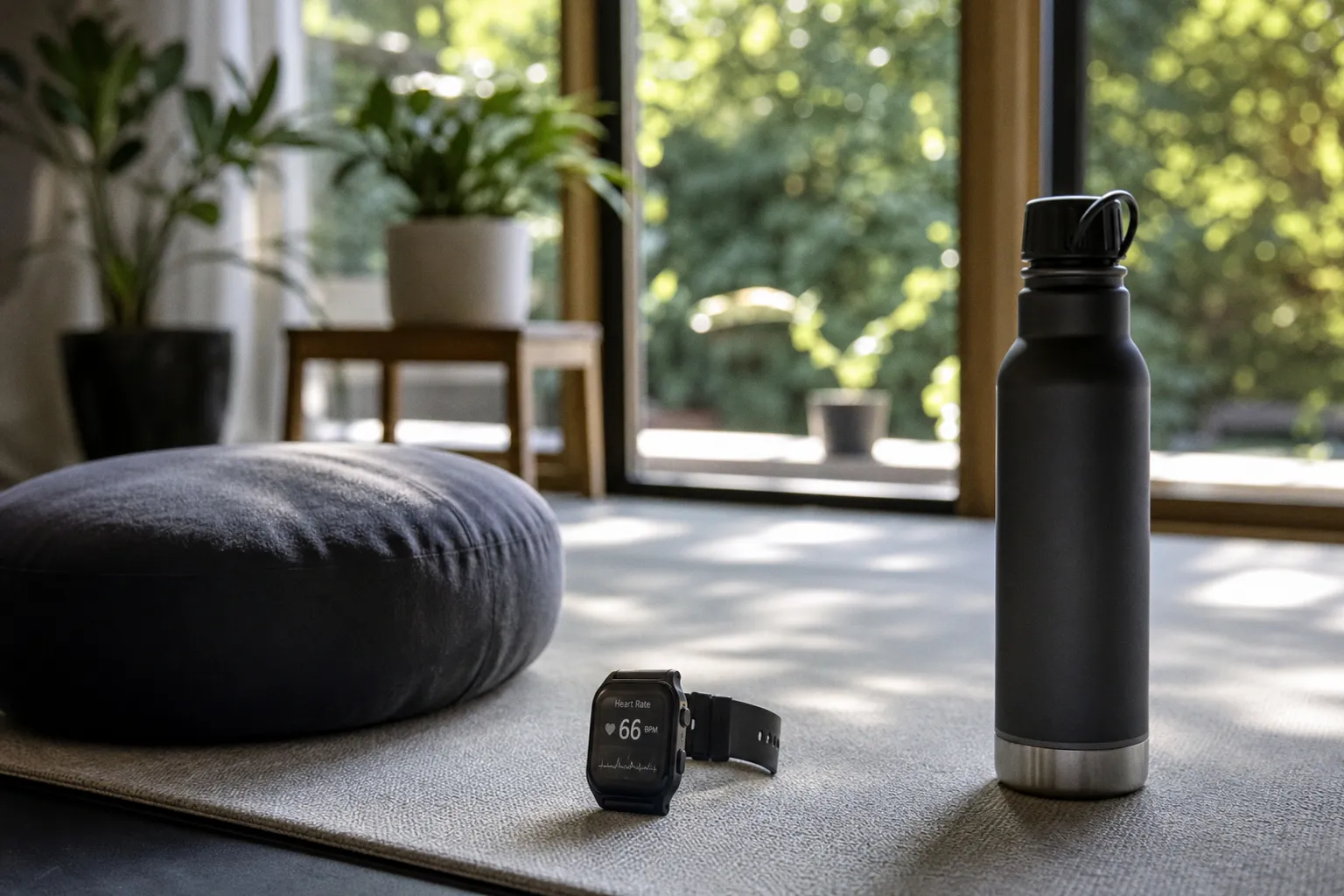
For readers who want to verify this in real time: a chest-strap heart rate monitor or ECG-grade smartwatch will display RMSSD or SDNN (standard deviation of NN intervals) during a five-minute box-breathing session. Most consumer devices will show a measurable increase within two to three minutes—provided you are not cognitively loading the system with anxious rumination while breathing. Mental bandwidth matters here; the breath cycle only works as a parasympathetic input if the prefrontal cortex is not simultaneously generating threat simulations.
Long-term HRV improvements require consistent practice, not acute episodes. A single 5-minute session raises HRV temporarily. Daily practice over six to twelve weeks appears to raise resting HRV baseline, possibly through neuroplastic remodeling of vagal pathways. Individual response varies, and the research on long-term autonomic remodeling is still maturing.
Interrupting the Cortisol Loop: Moving Beyond Immediate Stress Relief
Cortisol is the body's primary glucocorticoid stress hormone, secreted by the adrenal cortex via the hypothalamic-pituitary-adrenal (HPA) axis. The chain runs: stressor → amygdala activation → CRH release from hypothalamus → ACTH from pituitary → cortisol from adrenals. Cortisol then feeds back to the HPA axis to inhibit further release—but only if the system detects resolution of the original stressor.
In acute stress, this negative feedback loop works as designed. In chronic stress, the loop fails to close. Cortisol remains elevated, glucocorticoid receptor sensitivity decreases, and the amygdala continues firing sympathetic signals. This is the substrate of burnout and downstream cardiovascular damage. Chronic sympathetic activation also shifts the dopaminergic baseline toward threat-hypervigilance, which compounds the cognitive load of daily decision-making and erodes mental resilience over time.
Box breathing does not directly lower cortisol. It lowers the sympathetic input that drives cortisol secretion upstream. By reducing heart rate, lowering blood pressure, and increasing HRV within the first few cycles, paced breathing signals to the brainstem that the immediate threat has resolved. The amygdala's sympathetic output decreases. CRH and ACTH release falls. Cortisol secretion follows—typically within a 20-to-30-minute window.
Box breathing does not directly lower cortisol. It lowers the sympathetic input that drives cortisol secretion upstream.
This distinction matters. Box breathing is an acute intervention. It interrupts the loop in real time and creates a window in which the HPA axis can re-establish negative feedback. It is not a treatment for clinical anxiety disorders, PTSD, or chronic cardiovascular conditions. Anyone using paced breathing as a substitute for medical care is misapplying the tool.
The 5-Minute Box-Breathing Protocol
A measurable protocol for verifying the mechanism on your own physiology:
1. Baseline. Sit upright, feet flat on the floor, hands relaxed. Record resting heart rate and HRV (if your device supports it) after two minutes of quiet sitting. Note the values.
2. Cycle. Inhale through the nose for 4 seconds. Hold full for 4. Exhale through the mouth for 4. Hold empty for 4. Repeat continuously without counting gaps between cycles.
3. Duration. Run the cycle for 5 minutes—approximately 18 to 19 full cycles.
4. Post-measurement. Record heart rate and HRV again immediately after stopping. Expect a 5–15 bpm reduction in resting heart rate for most adults, and a measurable rise in RMSSD or SDNN.
5. Long-term baseline. Track daily for 6 weeks. Compare your week-six resting HRV to your week-one baseline. The trend line is what matters, not individual session values.
If you do not know your cardiovascular and metabolic starting point, autonomic self-monitoring is incomplete context. Broader preventive screening—age-appropriate bloodwork, blood pressure tracking, lipid panels—provides the baseline against which any autonomic intervention should be measured. ace-health.org covers age-stratified preventive checks that complement the kind of daily self-quantification this protocol demands.
The 4-4-4-4 cycle is not a relaxation technique. It is a mechanical input to a quantifiable autonomic reflex. Treat it as such, measure the output, and the data will tell you whether your nervous system is responding the way the physiology predicts.