Sleep becomes a trial signal, not just a complaint
The collaboration targets a known measurement problem in neuropsychiatric and neurodegenerative research: sleep disturbance is common, but scalable objective measurement remains difficult.
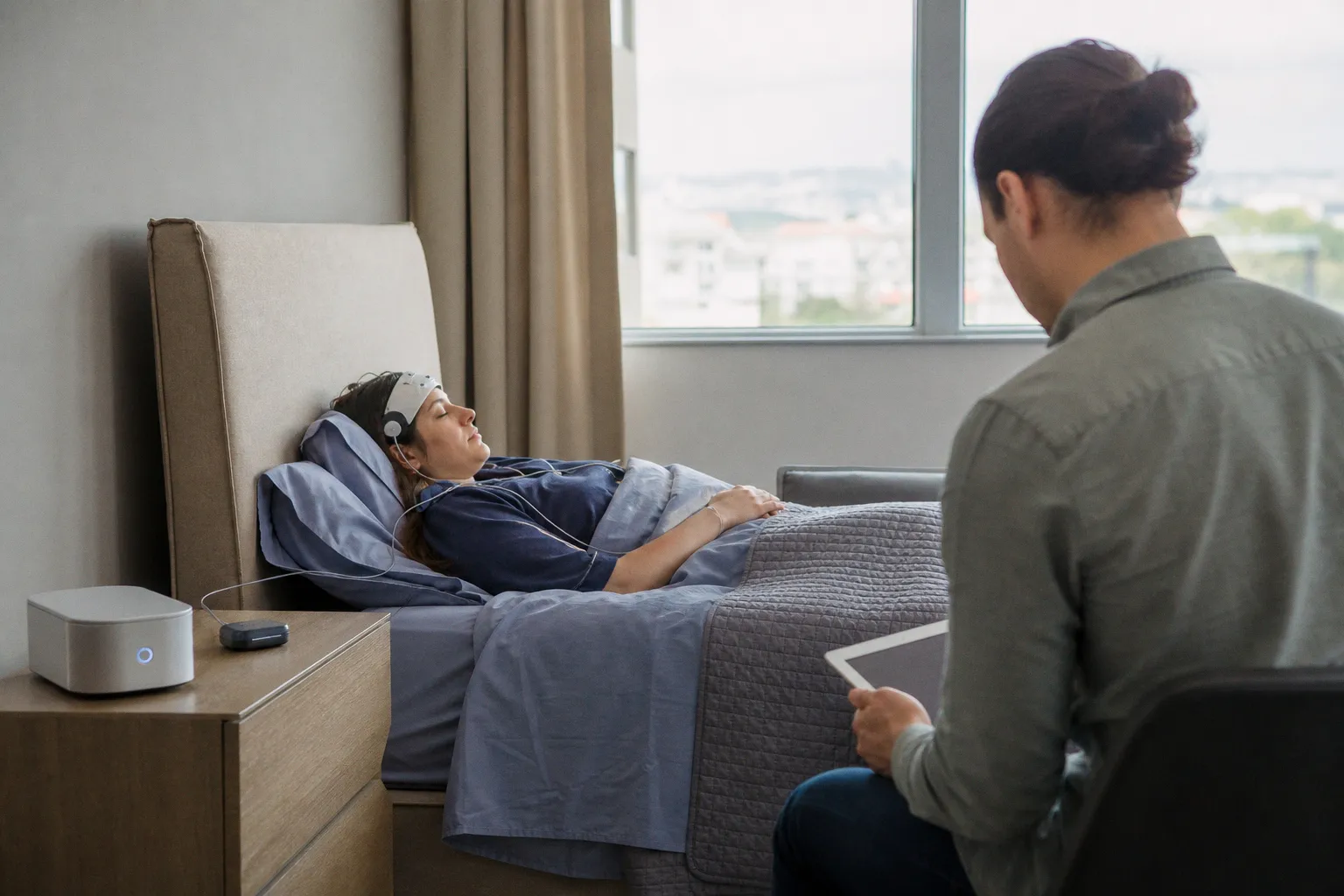
In-lab polysomnography is the reference method, but it is costly and intrusive. Many consumer wearables infer sleep from movement and heart-rate patterns. Muse’s pitch is different: its soft head-worn EEG device reads brain activity directly and resolves features used in sleep staging, including slow waves, spindles, and K-complexes.
That matters because the announcement frames sleep not only as a symptom but as a potential therapeutic target and biomarker. The release specifically points to disrupted deep sleep in the context of amyloid clearance and cognitive decline — an area of active interest in neurodegeneration research.
The important distinction: this is not a claim that a headband diagnoses disease. It is a claim that home-based EEG may support repeated, objective sleep architecture measurement inside CNS clinical trials.
What is actually being integrated
Cumulus says Muse’s at-home sleep EEG will power the sleep domain of the NeuLogiq platform. NeuLogiq is described as a multi-modal platform for CNS clinical trials, combining measures such as cognition, wake EEG, mood, speech, and now sleep EEG.
Muse reports that its sleep staging shows 88–96% agreement with gold-standard PSG, citing Lanthier et al., 2025 in SLEEP Advances. The companies also cite real-world scale: more than 16.8 million nights across over 500,000 users. Muse says its tools are supported by more than 200 third-party studies and that it has decoded over one billion minutes of brain data.
Those numbers are relevant, but they are not interchangeable. Agreement with PSG speaks to validation. User nights speak to scale and feasibility. Third-party studies speak to research footprint. A trial sponsor, clinic, or participant should not collapse these into a single vague claim of “clinical accuracy.”
Cumulus CEO Tina Sampath framed the integration around the need for objective longitudinal data in CNS development, arguing that subjective measures have dominated for too long. Muse CEO Jean-Michel Fournier emphasized home use, scale, comfort, and repeatability.
The integrated capabilities are scheduled to be presented at the Alzheimer’s Association International Conference 2026 in London, July 12–15.
What patients and clinics should check before saying yes
For a participant, the key question is not whether the device is “advanced.” It is what the study will do with the signal.
Before enrolling in a CNS trial using at-home sleep EEG, ask for clarity on:
- Which sleep metrics are primary, secondary, or exploratory endpoints.
- Whether raw EEG, scored sleep stages, or both are collected.
- How repeat nights are handled when data quality is poor.
- Who can access the recordings and derived sleep architecture.
- Whether the device is being used for research measurement, clinical decision-making, or both.
- What happens if the EEG suggests an abnormal sleep pattern.
- Whether home setup failures, discomfort, or non-wear time affect participation.
For clinics, the operational issue is latency: how quickly usable data become available, how failures are flagged, and whether staff must troubleshoot devices at scale. A low-burden wearable can still create high-burden workflows if the protocol does not specify escalation rules.
The measurable takeaway: at-home EEG sleep staging is moving from consumer wellness language into CNS trial infrastructure. That is a useful direction — if validation, endpoint definitions, data governance, and patient burden are explicit before the first night of recording.