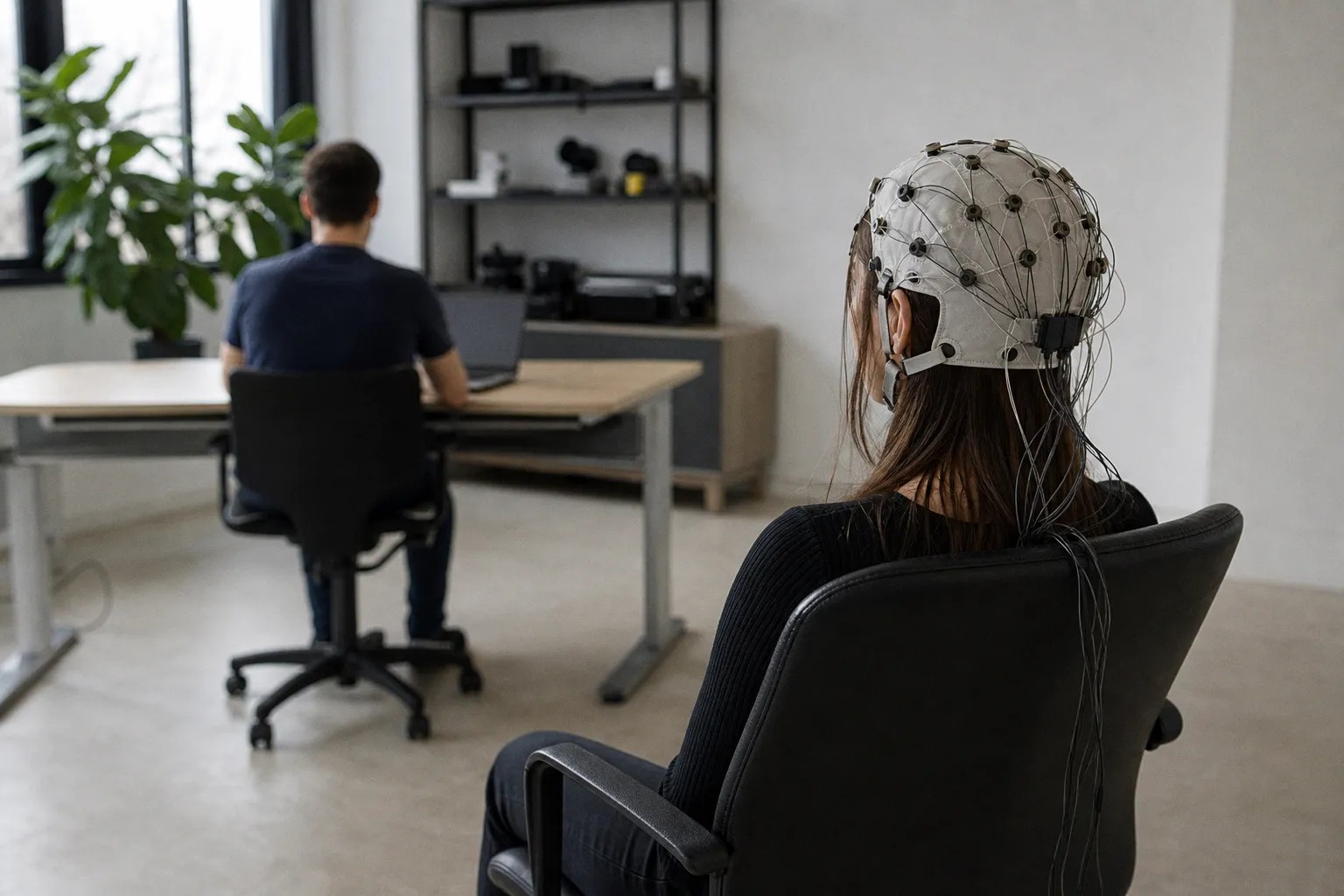
According to Neuroscience News, Carnegie Mellon researchers led by biomedical engineer Bin He developed a sensory-guided joint-learning framework for noninvasive BCIs. The work, published in Nature Communications, is presented as a step toward neural interfaces that are safer, less costly and more broadly accessible than implanted systems. For people living with motor limitations, that possibility matters—but it is not yet the same thing as a treatment available in a clinic.
The interface learns, and so does the person
Brain–computer interfaces translate patterns of neural activity into actions such as moving a cursor or controlling an assistive device. The difficult part has long been calibration: a person learns through attempts, feedback and adjustment, while an algorithm updates through mathematical optimization. When those processes pull in different directions, progress can stall.
The new framework aims to synchronize them. Researchers used structured tactile guidance to help participants shape their strategies, while adaptive algorithms gave more weight to neural patterns that were especially informative. In other words, feedback was not treated as a small add-on. It became part of the learning loop.
In a study involving 31 able-bodied people who had not previously used BCIs, participants showed rapid and sustained improvement in motor-imagery control as tasks became more complex. Reported average accuracy was 86% for one-dimensional cursor control and 77.5% for two-dimensional cursor control. Continuous-control results were lower: 77.5% in one dimension and 66.9% in two.
These figures are encouraging within the conditions of this study. They do not tell us, on their own, how the system will perform for a person with a neurological injury or condition, in a home environment, or over months of daily use. That distinction is worth anchoring ourselves to: promising control in a research setting is not a promise of clinical access.
Why “noninvasive” deserves a closer look
Implanted brain devices have been used to help disabled people complete motor tasks, but the source notes that surgery carries inherent risk and that costs have limited access. Noninvasive systems seek a different trade-off: potentially fewer procedural barriers, but historically less precise and more difficult control.
For patients and families, the word noninvasive can sound like a guarantee that there is little to consider. It is better understood as one feature of a technology, not a verdict on whether it fits your situation. If a BCI study or service is offered, we can slow the decision down and ask practical questions:
- Is this research participation, a clinical service, or a consumer product?
- What task is the system actually designed to support?
- How much training is expected, and what happens if control remains inconsistent?
- What data are recorded during use, who can access them, and how are they stored?
- Which costs are covered now, and what support exists after a study ends?
Those questions are not cynicism. They are a way to protect cognitive bandwidth at a time when hope, urgency and unfamiliar technical language can make every decision feel heavier.
A signal of direction—not a shortcut
The most meaningful element here may be the insistence that human learning is not noise for a machine to overcome. The user’s feedback, practice and changing strategy are part of the system. That is a healthier frame for assistive technology: not a device that simply “fixes” a person, but a tool whose usefulness depends on a real partnership between person, design and support.
It also places this work within a wider public-health conversation about who gets to benefit when research moves toward real-world care. Institutional plans, such as Wayne State’s proposed public health school, remind us that access is shaped not only by inventions but by the systems that train professionals, fund research and support communities.
For now, the next thing to watch is replication beyond untrained, able-bodied participants—and evidence that this approach can reliably help the people it is intended to serve. Until then, a small useful habit is to keep a one-page question list before any technology consultation: purpose, evidence, training, data, cost, follow-up. When the information is complex, that page can help us stay connected to what we actually need to know.