What Is a Brain-Computer Interface? A Neural Signal's Journey from Microvolts to Digital Commands
A single cortical neuron fires at roughly 70 millivolts at the membrane — an electrical event that, by the time it reaches the scalp, has been attenuated by skull and tissue to between 10 and 100 microvolts. Modern brain-computer interfaces recover that signal, clean it, classify it, and translate it into a digital command without any peripheral nerve firing. A brain-computer interface (BCI) is a direct communication pathway between neural tissue and an external device. It bypasses the neuromuscular system entirely. It records electrical activity, filters artifacts, extracts features, classifies intent, and outputs a command — to a cursor, a prosthesis, a therapeutic stimulator, or a consumer application.
What began as a 1973 academic paper by Jacques Vidal at UCLA has matured into a regulated medical category with multiple FDA-cleared systems and a parallel consumer-grade ecosystem. Understanding how a neural signal travels from cortex to digital command requires following five tightly coupled processing stages. The pipeline is unforgiving: noise introduced in millisecond one corrupts classification at stage four. The path is the same whether you are decoding imagined hand movement with a 1,024-channel cortical array or tracking meditation depth with an 8-channel consumer headset. Only the fidelity changes.
The Five-Stage BCI Signal Processing Pipeline
Every functional BCI executes the same five-stage architecture. The methods differ by invasiveness tier and target application; the sequence does not.
| Stage | Function | Typical Methods |
|---|---|---|
| Signal Acquisition | Detect electrical, magnetic, or metabolic brain activity | Intracortical microelectrodes, ECoG grids, scalp EEG, fNIRS |
| Preprocessing | Remove drift, line noise, ocular and muscle artifacts | Bandpass filtering (0.5–100 Hz), common average reference, ICA, notch filters |
| Feature Extraction | Identify discriminative patterns in cleaned signal | Band power (delta, theta, alpha, beta, gamma), ERP components, spectral entropy, spike timing |
| Classification | Map features to discrete intentions or continuous states | Linear discriminant analysis, SVM, CNN/LSTM deep learning, Kalman filters |
| Output | Translate decoded state into device command | Cursor velocity, prosthesis actuation, text selection, closed-loop stimulation |
A neural signal is not a sentence. It is a noisy, time-locked statistical distribution — and the pipeline is the decoder.
The voltage differential that initiates this cascade is small. The 0.25 microvolt RMS noise floor of a Neurosity Crown sits just above the threshold where a meaningful EEG feature becomes recoverable at the scalp. Invasive arrays capture the opposite end of the dynamic range, with electrodes reading local field potentials from thousands of neurons simultaneously.
Signal Acquisition: Electrodes, Placement, and the 10-20 System
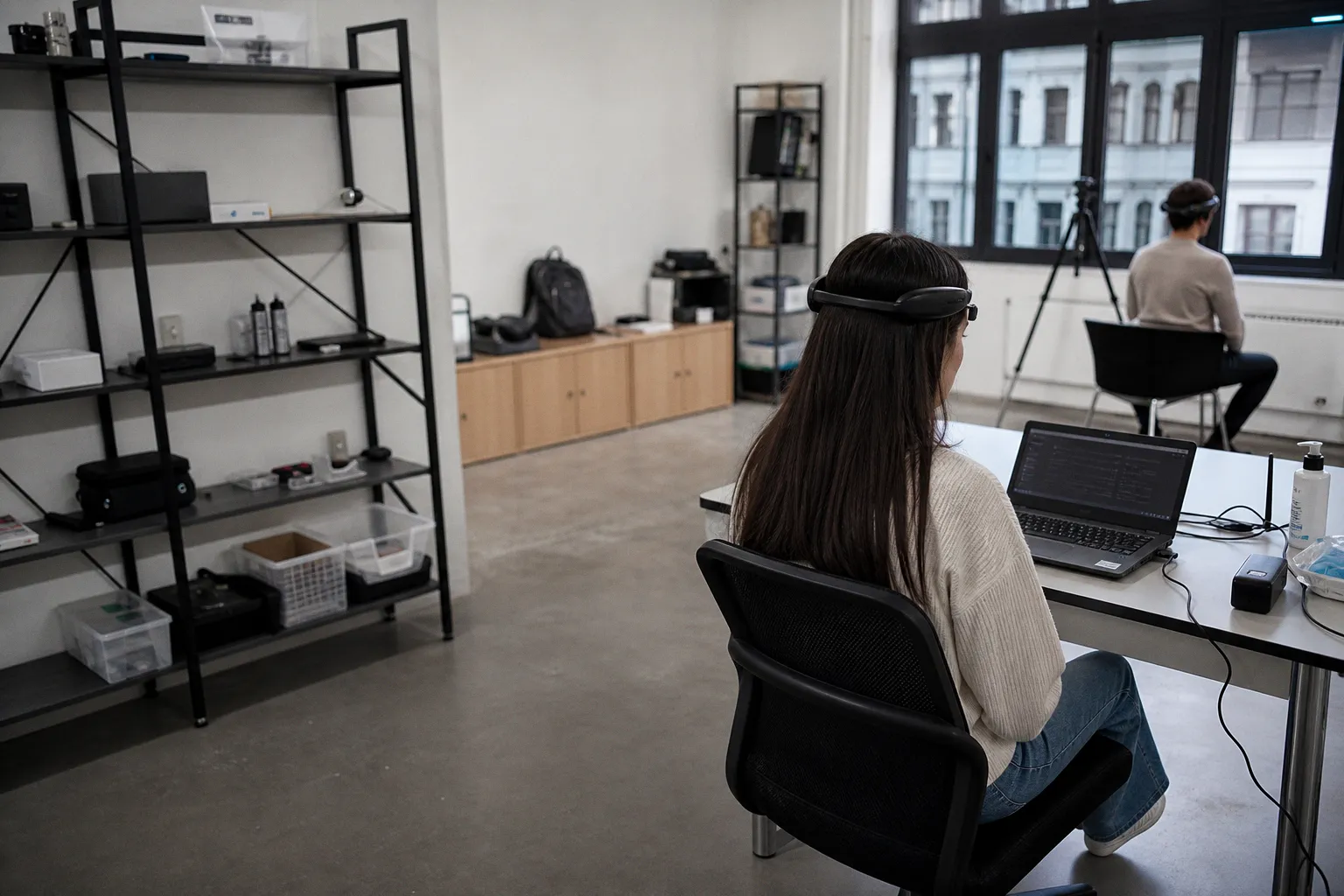
Electrode placement determines what is measurable. The international 10-20 system standardizes scalp positioning using four skull landmarks (nasion, inion, and preauricular points), with electrode sites labeled by lobe (Fp, F, C, P, O) and hemisphere (odd numbers left, even right). This standardization enables reproducible research across labs and consistent consumer-device design. An 8-channel consumer headset like the Neurosity Crown distributes dry electrodes across frontal, central, parietal, and occipital lobes to sample distributed cortical activity at 256 Hz — sufficient temporal resolution to track alpha-band oscillations linked to relaxed wakefulness and beta-band activity tied to active concentration.
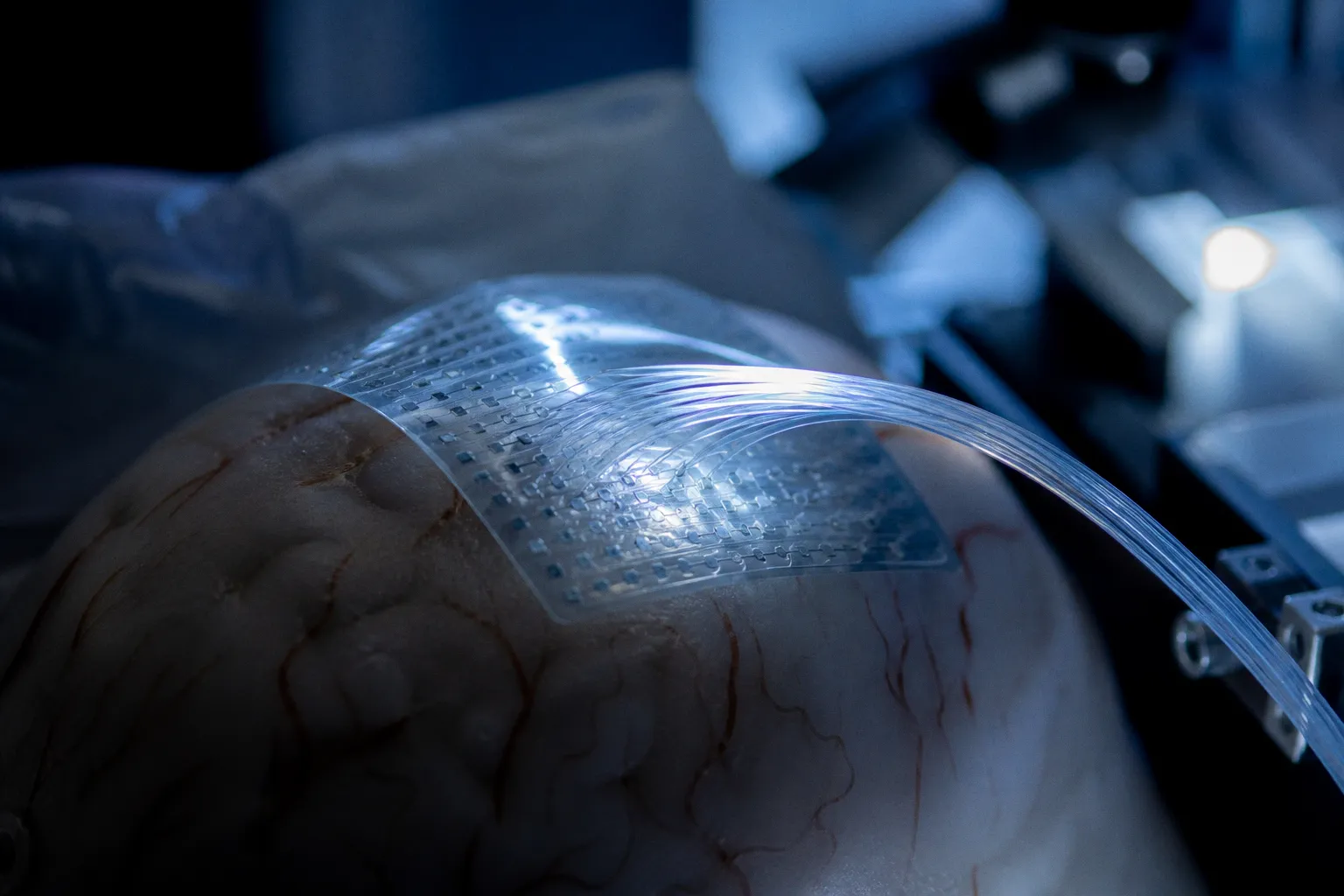
Invasive systems operate under different physics. Precision Neuroscience's Layer 7 Cortical Interface, cleared by the FDA in April 2025 for temporary implantation up to 30 days, embeds 1,024 microelectrodes on a flexible thin-film array that conforms to the cortical surface without penetrating the pia. Each electrode samples local field potentials from a population of neurons, yielding signal-to-noise ratios that scalp EEG cannot approach. The architecture is a hybrid: high channel count without the glial scarring and long-term stability questions of penetrating intracortical probes. High-density wireless systems based on FPGA technology now push to 1,024 channels at 32 kSPS, capturing single-unit and multi-unit spiking activity in real time.
Preprocessing and Feature Extraction: Cleaning the Noise Floor
Raw neural data is contaminated before it reaches the classifier. Powerline interference at 50 or 60 Hz sits directly on top of beta-band EEG. Electrode-skin impedance drift introduces slow oscillations below 0.5 Hz. Ocular artifacts from blinks reach 100–400 microvolts — an order of magnitude larger than the EEG signal itself. EMG contamination from facial and cervical muscles adds broadband high-frequency noise that mimics cortical gamma activity.
Preprocessing addresses each artifact class in sequence. High-pass filters eliminate DC drift. Low-pass filters cut muscle artifact and high-frequency noise above 100 Hz for EEG, or set anti-aliasing cutoffs for sampled invasive data. A 50/60 Hz notch filter removes line noise. Independent component analysis (ICA) decomposes the multichannel signal into statistically independent sources, identifies stereotyped ocular and cardiac components by topography and time course, and reconstructs the signal without those components. The output is a cleaned multichannel time series ready for feature extraction.
Feature extraction identifies which dimensions of the cleaned signal carry task-relevant information. EEG-based BCIs rely overwhelmingly on band power across canonical frequency ranges: delta (0.5–4 Hz, deep sleep), theta (4–8 Hz, drowsiness and memory encoding), alpha (8–13 Hz, relaxed wakefulness), beta (13–30 Hz, active cognition), and low gamma (30–50 Hz, feature binding). Motor imagery BCIs extract event-related desynchronization — a localized drop in mu and beta power over sensorimotor cortex when the user imagines moving a hand. P300 spellers detect a positive voltage deflection peaking approximately 300 ms after a rare target stimulus flashes among non-targets, enabling letter selection without any motor output.
Invasive systems extract different feature classes: spike rates, spike timing patterns, and local field potential band power in higher frequency ranges inaccessible to scalp recording. The classification problem shifts from "which frequency band dominates" to "which population of neurons fires in which temporal pattern relative to behavioral events."
Classification: From Probabilistic Models to Closed-Loop Control
Classification is where the pipeline becomes probabilistic. Linear models — linear discriminant analysis, logistic regression on band-power features — remain dominant in EEG-based BCIs because they generalize across sessions and users with minimal calibration data. A subject can sit down, perform a 2-minute calibration task, and produce a usable motor imagery classifier. Deep learning has entered the field: convolutional neural networks applied to time-frequency spectrograms detect microsleep events, attention lapses, and seizure precursors with higher accuracy than handcrafted features, but they require larger training sets, more computational overhead, and careful regularization to avoid overfitting session-specific noise.
For invasive motor BCIs, the classification target is continuous rather than discrete. Recurrent neural network architectures and Kalman filters track neural state dynamics in continuous time, producing velocity and position estimates for robotic arms, cursors, or virtual effectors. The critical performance metric is closed-loop latency — the delay between neural intent and device response. Latencies under 100 ms feel natural to users. Above 200 ms, users consistently disengage, reporting that the device no longer feels like an extension of intention.
Closed-loop latency is the difference between a user controlling a cursor and a cursor chasing a user.
Clinical Frontiers: Precision Neuroscience, CorTec, and the 2025–2026 Regulatory Inflection
Two recent regulatory milestones redefine the clinical boundary of BCI technology. In April 2025, the FDA granted 510(k) clearance to Precision Neuroscience's Layer 7 Cortical Interface — the first high-density cortical array approved for temporary use. At 1,024 microelectrodes on a flexible thin film, it provides electrophysiological mapping resolution relevant for neurosurgical planning and, potentially, temporary communication restoration in patients with locked-in syndrome. The 30-day implantation window limits long-term signal-degradation studies but establishes regulatory precedent for high-channel-count, non-penetrating cortical interfaces.
In April 2026, the FDA granted Breakthrough Device Designation to CorTec's Brain Interchange system — the first BCI worldwide designated specifically for stroke motor rehabilitation using direct cortical electrical stimulation. The architecture is bidirectional: the implanted array records residual motor intent from peri-infarct cortex, decodes the intended movement pattern, and delivers patterned stimulation to the same region or to downstream motor structures to reinforce neural pathways during attempted movement. The closed-loop stimulation-rehabilitation paradigm marks a transition from BCIs as decoders to BCIs as active therapeutic platforms — devices that do not just read the brain but modulate it in task-locked time.
These advances sit on a regulatory foundation laid on May 20, 2021, when the FDA issued its final guidance on Implanted BCI Devices for Patients with Paralysis or Amputation. That document established the first formal framework for premarket evaluation of invasive neural interfaces and clarified the agency's evidentiary expectations for chronic implantation safety, signal stability, and cybersecurity.
Consumer-Grade Neurotech: Tracking States, Not Diagnosing Disease
The same five-stage pipeline powers consumer devices, with different targets. A Neurosity Crown samples 8 channels of EEG at 256 Hz; consumer headsets like the Muse 2 use their own multi-channel configurations at comparable sample rates. Both extract band-power features across alpha, beta, and theta, and both classify cognitive state — focus, flow, calm, drowsy — for end-user feedback through a smartphone or desktop application. Use cases are wellness-oriented: meditation tracking, attention training, sleep onset detection, and longitudinal trend monitoring.
These devices do not read complex thoughts, decode memories, or diagnose psychiatric conditions. They classify pre-defined oscillatory patterns correlated with subjective state reports and behavioral benchmarks. The noise floor of consumer hardware limits inference granularity. What consumer neurotech offers is longitudinal state tracking: minutes spent in high beta (active focus), transitions between alpha and theta (depth of relaxation), and frontal alpha asymmetry (a spectral correlate of approach-versus-withdrawal motivational orientation).
Consumer BCIs do not read minds. They read the spectral signature of your attention.
This distinction matters for both user expectations and clinical interpretation. Consumer devices are validated against self-report, not against clinical gold standards. EEG-derived "focus" metrics correlate modestly with task performance and do not map cleanly onto psychiatric diagnostic categories. They are tools for state awareness, not instruments for clinical inference.
Types of Brain-Computer Interfaces by Invasiveness
Three tiers structure the BCI landscape, each trading signal fidelity for surgical risk:
1. Non-invasive (EEG, MEG, fNIRS) — Surface electrodes or optical sensors read summed cortical activity through skull and tissue. Zero surgical risk. Spatial resolution limited to centimeters; temporal resolution high. Dominant in consumer applications, neurofeedback clinics, and large-scale research.
2. Semi-invasive (electrocorticography, subdural arrays) — Electrodes sit on the cortical surface beneath the dura. Higher spatial resolution and signal amplitude than EEG. Currently used in epilepsy monitoring and investigational motor BCIs.
3. Invasive (intracortical microelectrode arrays) — Penetrating electrodes record single-unit and multi-unit spiking activity from individual neurons. Highest signal fidelity. Surgical risk, foreign body response, and long-term biocompatibility questions remain active research concerns.
Each tier supports the same pipeline architecture but produces fundamentally different feature spaces. EEG yields band power. ECoG yields high gamma activity and ERP morphology at higher amplitude. Intracortical arrays yield spike timing and population dynamics. The clinical question determines which tier is appropriate; the engineering tradeoffs are settled by the physics of signal propagation through tissue.
The Field's Open Questions
Three questions remain unresolved as of mid-2026. First, the long-term biocompatibility of invasive microelectrode arrays: whether chronic tissue response, glial scarring, and mechanical micromotion degrade signal stability over years of continuous implantation. Animal studies suggest significant signal loss within 24 months for penetrating silicon arrays; whether thin-film surface arrays avoid this trajectory is an open empirical question. Second, the regulatory pathway for fully implantable, high-bandwidth systems intended for permanent use in non-clinical populations. Current clearances are 30-day investigational indications or Breakthrough Designations for specific disease states. General-purpose cognitive enhancement remains outside the regulatory frame. Third, the validation standards that will distinguish clinical-grade neurofeedback from consumer neurofeedback — what evidentiary threshold separates a regulated therapeutic claim from a wellness application.
Each question sits at the intersection of neuroscience, materials science, and regulatory science. The answers will determine whether BCI technology remains a narrow clinical specialty for paralysis and stroke rehabilitation or expands into a general-purpose cognitive interface layer over the next decade. The pipeline architecture will not change. The fidelity, the regulatory envelope, and the user population will.