It is also a course that the U.S. Food and Drug Administration has not cleared as an ADHD treatment. The agency has cleared an EEG-based diagnostic aid to help clinicians evaluate ADHD. It has cleared a low-current trigeminal nerve stimulation device that does not rely on feedback. It has cleared a digital game-based therapeutic for adult ADHD. Neurofeedback itself remains in regulatory silence. Below the marketing surfaces, the data on which protocols work, on how long effects persist, and on whether the conditioning generalizes beyond the chair, is still moving.
The mechanics of the chair: how EEG sensors translate brainwaves into feedback
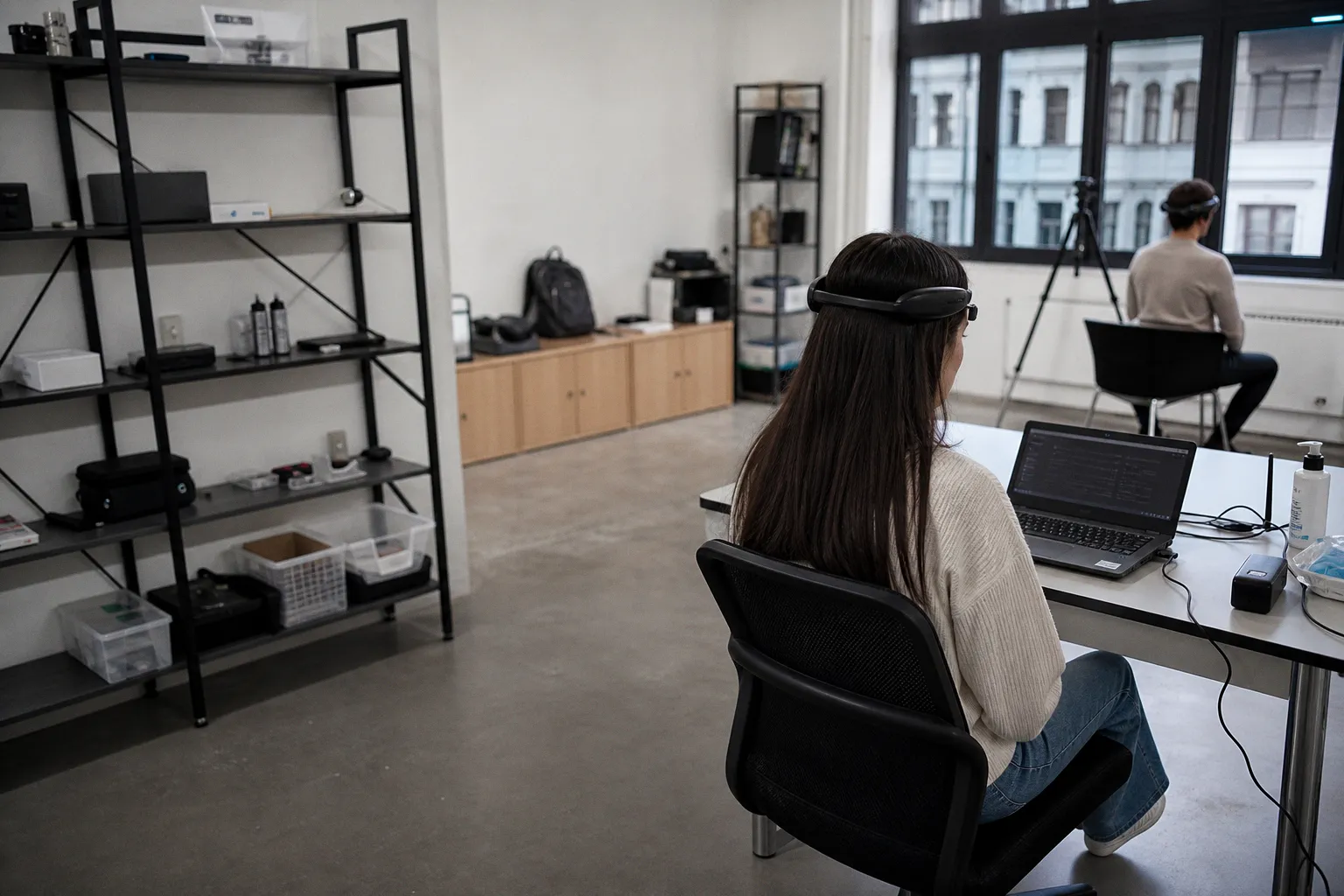
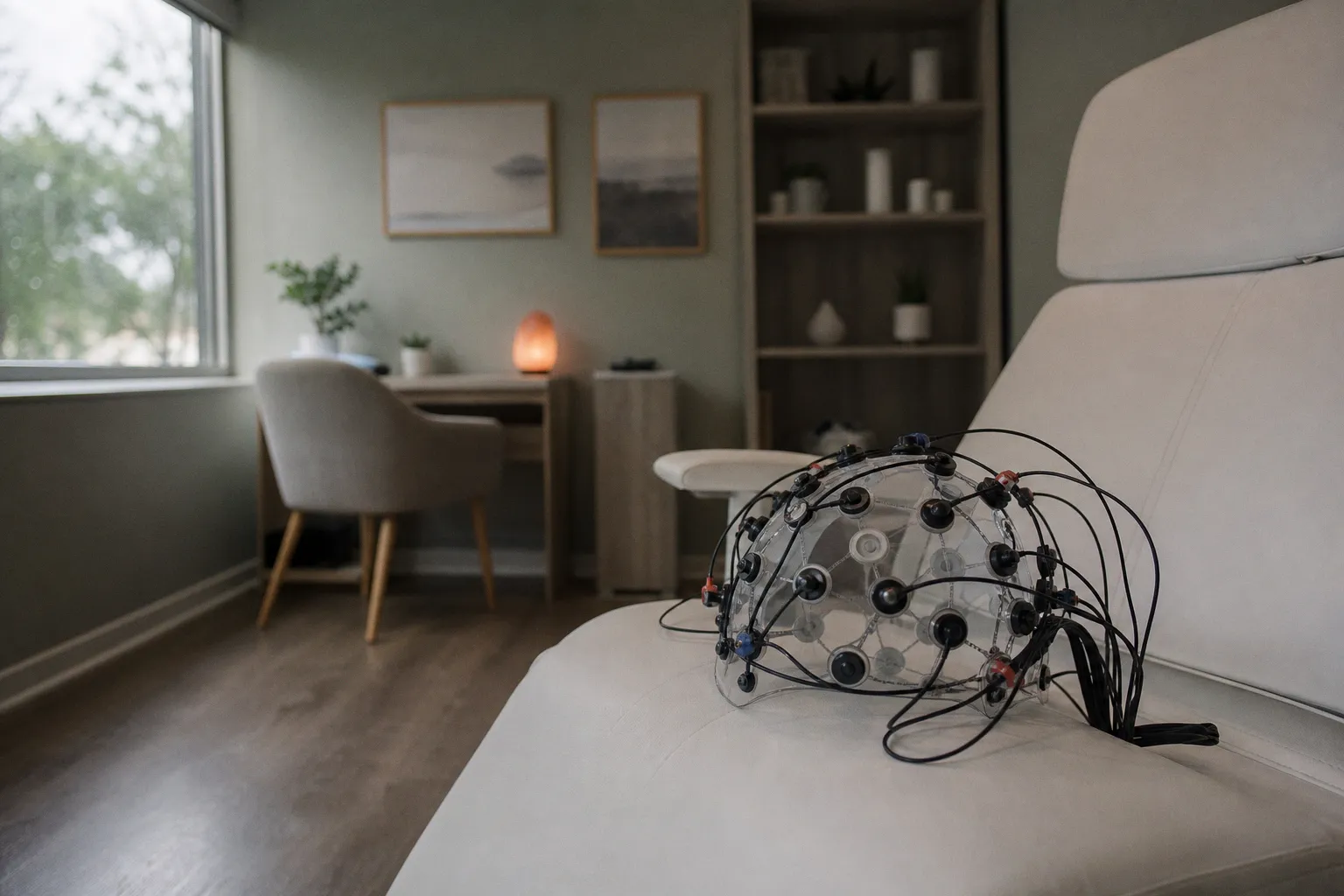
The hardware is unglamorous. A clinician applies 3 to 5 non-invasive electrodes using the 10–20 international placement system: standardized scalp coordinates that anchor sensors at reproducible locations session to session. The most common sites for ADHD protocols are Cz at the vertex, Fz at the midline frontal region, and C4 over the right sensorimotor cortex. Reference electrodes clip to the earlobes. Conductive paste bridges skin and sensor.
The electrodes are passive. They read voltage fluctuations on the order of microvolts. They do not deliver current into the brain. They do not stimulate. They measure. The EEG amplifier samples at typically 256 Hz or higher, and software decomposes the signal into frequency bands defined by their oscillatory characteristics:
- Delta, 0.5–4 Hz, dominant in deep sleep.
- Theta, 4–8 Hz, elevated during drowsiness and under-arousal states.
- Alpha, 8–13 Hz, dominant in relaxed wakefulness.
- Beta, 13–30 Hz, dominant during active cognitive effort.
- Gamma, above 30 Hz, associated with feature binding and focused attention.
Two of these bands sit at the center of every clinical ADHD neurofeedback protocol. The remainder is the substrate they sit inside.
The scalp is read, not zapped. The EEG amplifier samples voltage fluctuations on the order of microvolts and decomposes the signal into frequency bands. No current enters the brain.
Targeting the ADHD brain: Theta/Beta ratios and sensorimotor rhythm protocols
Two protocols dominate clinical ADHD neurofeedback. The choice depends on which symptoms a clinician wants to target and what the baseline EEG looks like.
Theta/Beta Ratio (TBR) training. This is the most frequently deployed ADHD protocol. The intervention suppresses power in the 4–8 Hz theta band and rewards power in the 13–20 Hz beta band. The rationale is grounded in EEG phenotyping: elevated frontal theta relative to beta correlates with cortical under-arousal and inattention in ADHD. The goal is to push the ratio in the opposite direction, lower TBR, higher beta, across training sessions. Standard electrode placement is Cz or Fz, midline sites that capture the frontal midline theta signature.
Sensorimotor Rhythm (SMR) training. SMR occupies the 12–15 Hz sub-band of beta, recorded primarily over C4. The target differs from TBR. SMR protocols reward amplitude in this motor cortex rhythm, with the aim of suppressing motor restlessness, reducing impulsivity, and shortening sleep onset latency. Clinicians typically deploy SMR when the dominant ADHD presentation is hyperactive-impulsive rather than inattentive.
| Parameter | TBR protocol | SMR protocol |
|---|---|---|
| Frequency targets | Suppress theta (4–8 Hz); reward beta (13–20 Hz) | Reward SMR (12–15 Hz) |
| Primary electrode site | Cz or Fz (midline frontal) | C4 (right sensorimotor cortex) |
| Phenotype focus | Inattentive, cortical under-arousal | Hyperactive-impulsive, motor restlessness |
| Hypothesized mechanism | Reward cortical arousal in midline executive regions | Reward 12–15 Hz rhythm to inhibit motor output and stabilize arousal |
| Typical feedback modality | Game progress, screen brightness, audio volume | Same modalities, tuned to SMR amplitude |
A patient should know which protocol a clinic intends to run before signing up. Both have published evidence. Both have contested efficacy at the group level. The decision between them depends on symptom phenotype and the clinician's reading of the baseline EEG, not on marketing copy.
The operant conditioning loop: rewarding focus in real-time
The intervention runs on operant conditioning at the level of cortical oscillations. Real-time signal processing extracts the target frequency band from the live EEG stream and converts its amplitude into a feedback variable: a game score, a screen brightness, an audio level, a video advancement. When the patient's brainwaves meet the threshold, the system delivers a reward. When they drift, the reward disappears or inverts into negative feedback.
The training loop repeats hundreds of times per session. The brain learns. The cortical oscillation upregulates. The effect is measurable in the EEG signal within a session, often by the second or third pass through the threshold.
The empirical hinge of the entire therapy sits one step downstream. A patient can reliably up-regulate beta amplitude on demand while the visual reward sits in front of them. Whether that voluntary upregulation translates into sustained attentional capacity during a calculus exam, a board meeting, or a child listening to a teacher read aloud is the question the sham-controlled literature has yet to settle. The conditioning is real. The transfer is contested.
The commitment curve: session frequency, duration, and financial investment
The math is straightforward and unforgiving. Multiply sessions by per-session cost and add travel time. A representative course:
| Course size | Per-session cost | Estimated total | Session time only |
|---|---|---|---|
| 20 sessions | $80 | $1,600 | ~17 hours |
| 30 sessions | $130 | $3,900 | ~30 hours |
| 40 sessions | $150 | $6,000 | ~40 hours |
| 40 sessions | $200 | $8,000 | ~40 hours |
Reimbursement reality is blunt. Most U.S. insurers classify neurofeedback for ADHD as experimental or investigational. Patient pays out of pocket. Some Health Savings Accounts and Flexible Spending Accounts reimburse the cost with a letter of medical necessity. Some practices offer sliding-scale fees. Few practices bundle outcome guarantees.
Time cost scales the same way. Twenty weekly sessions at 45 minutes each, plus travel, is roughly 20 hours of presence. Forty sessions at 60 minutes each is closer to 45 hours. The time is real, the spend is real, and the candidate should plan both before the first electrode goes on.
Home-based neurofeedback devices, headbands and headsets marketed directly to consumers for ADHD symptom management, reduce the per-session dollar cost but introduce a different variable: whether unsupervised, uncalibrated home EEG produces the same cortical conditioning as a clinician-guided in-clinic session. The comparison is empirically open in the published literature.
Navigating the evidence: why clinical consensus remains elusive
The evidence base is heterogeneous and contested. Open-label trials report large effect sizes and parent-reported symptom improvement. Recent double-blind, sham-controlled trials and meta-analyses push those effects toward zero at the group level. The sham condition is technically demanding: blinding a participant to whether they receive real feedback versus sham feedback is non-trivial when the visual and auditory rewards are salient, and patients in the sham arm often report that something feels missing.
Three FDA actions clarify the regulatory status as of 2026:
- July 2013. FDA cleared the NEBA Health System, an EEG-based diagnostic aid that helps clinicians evaluate ADHD by measuring theta/beta ratios at Cz. Diagnostic aid, not treatment.
- April 2019. FDA cleared the Monarch eTNS System, a low-current external trigeminal nerve stimulation device for pediatric ADHD. It sends current through trigeminal nerve branches to modulate cortical activity. It does not provide feedback. It is sometimes confused with neurofeedback. It is not neurofeedback.
- January 2026. FDA cleared Lumosity Rx, a digital game-based cognitive therapeutic for adult ADHD. Software-based, not EEG-based.
None of the three clears neurofeedback as a treatment. That regulatory silence is the most consequential fact in the field.
Three FDA actions clarify the regulatory status. None of them clears neurofeedback as an ADHD treatment. That regulatory silence is the most consequential fact in the field.
What the candidate should measure, before and after:
- Baseline theta/beta ratio at Cz, SMR amplitude at C4.
- Quantitative behavior: attention span on a task, sleep onset latency, homework completion rates, missed deadlines.
- Standardized rating scales: Conners, ADHD-RS, or Vanderbilt, administered at session 0, session 15, and session 40.
- Side-effect log (the intervention is non-invasive; the log exists to rule out confounders).
A measurable decision framework
Neurofeedback occupies a precise clinical position. The hardware is non-invasive. The protocol is grounded in measurable physiology. Theta and beta oscillations are real. The EEG signal is real. The operant conditioning is real. The therapy is also expensive: $2,000 to $8,000 per course, rarely reimbursed. The outcome is contested: positive in open-label trials, equivocal in sham-controlled trials, unconfirmed at the FDA level. Patients do not get shocked. They also do not get a guarantee.
A workable protocol for the candidate who decides to proceed:
1. Confirm protocol type in writing. TBR or SMR, named explicitly.
2. Request baseline and intermediate EEG data. Compare session 0, session 15, and session 40.
3. Lock total cost, session count, and refund policy into a written agreement.
4. Choose measurement: behavioral metric, rating scale, or both. Decide before the course starts.
5. Decide status relative to medication: complement or replacement. Do not let the clinic decide for you.
6. Re-evaluate at the 15-session mark. If the rating scale shows no movement and the EEG shows no movement, redirect resources to a protocol with a stronger effect-size signal, such as medication or cognitive behavioral therapy, or to a clinician with published outcome data.
The chair holds still. The signal is read. The question of whether the reading reorganizes attention outside the clinic remains, for now, a question the data has not closed.