It is a useful story for movie trailers. It is also a poor definition.
A brain-computer interface, or BCI, is a system that measures activity in the central nervous system, interprets a usable pattern, and turns that pattern into an output: a cursor moves, a letter appears, a speech synthesizer talks, a robotic limb responds. The critical detail is not “brain signals.” Plenty of devices record brain signals. The critical detail is the loop from neural activity to an external action, without requiring the person’s usual muscle-and-nerve output pathway.
That distinction becomes painfully concrete when someone has lost speech or movement. For a person with paralysis, a BCI is not a novelty interface. It can be a route back into a conversation. For everyone else, it is increasingly a question with less glamorous packaging: if technology can cross the boundary between thought, intention, and action, who sets the defaults?
A BCI is not a machine that reads a mind. It is a machine that learns a narrow, trained route from neural activity to an output.
What does a brain-computer interface actually do?
The basic brain machine interface definition is simple enough to fit on a whiteboard: acquire a signal, decode it, produce an output. The lived reality is much messier, because brains do not issue clean API calls.
Neural activity is noisy, variable, and highly dependent on context. A person can be tired, distracted, anxious, undertrained, or simply having the kind of day when their attention keeps sliding off the task. In ordinary software, that is a user-experience problem. In a BCI, it can determine whether the system works at all.
The system usually contains three layers:
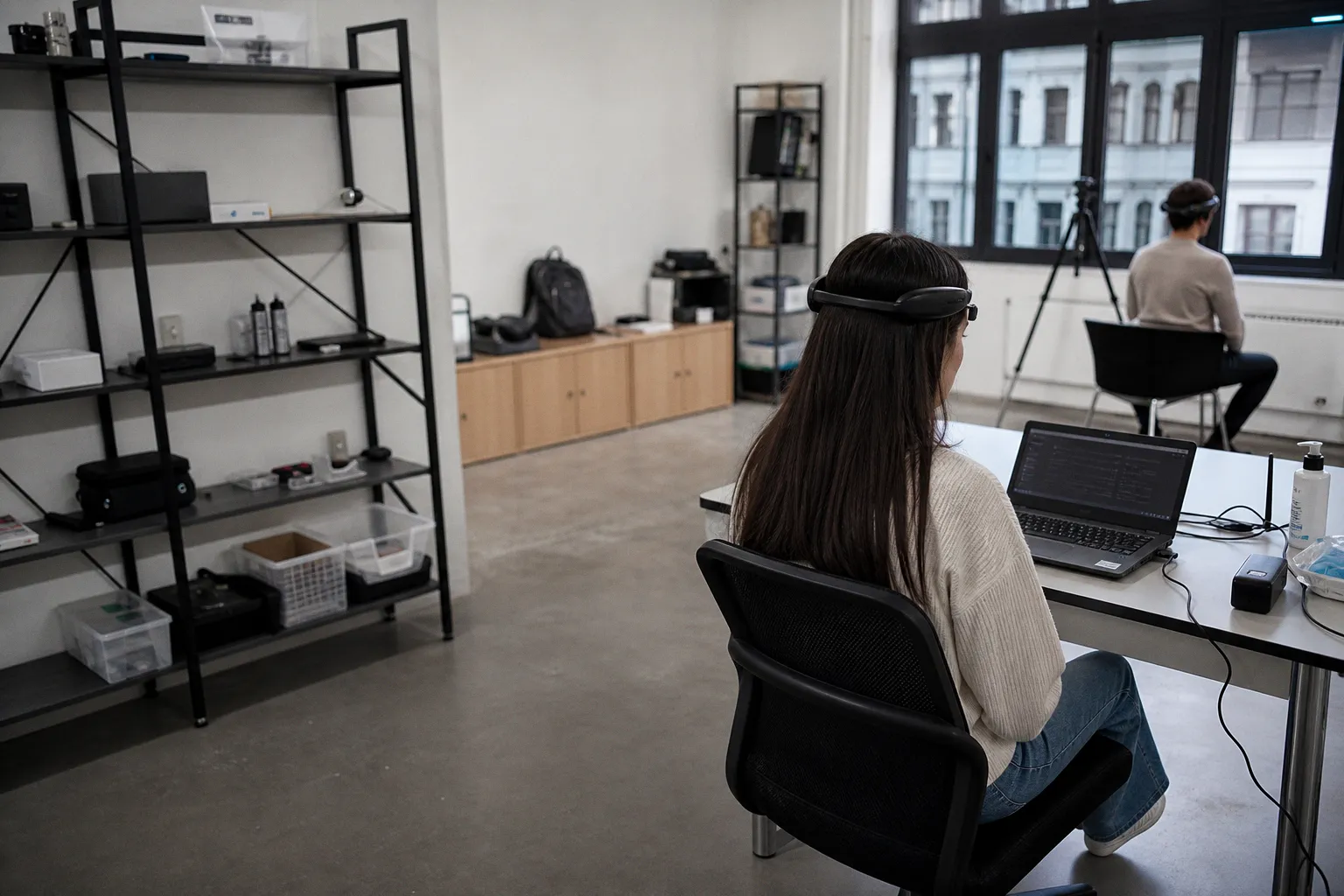
1. Signal acquisition. Sensors capture activity from the brain or nearby neural tissue. This may happen outside the skull with EEG, MEG, or functional near-infrared spectroscopy (fNIRS); closer to the brain with approaches such as electrocorticography; or inside the brain with implanted electrode arrays.
2. Signal decoding. Software identifies patterns associated with a specific task. Depending on the system, that might mean attempting a hand movement, focusing on a visual target, imagining motion, or trying to speak.
3. Output and feedback. The decoded pattern controls something: a cursor, communication software, a robotic device, a spelling interface, or an artificial voice. The user sees or hears the result, adjusts, and the decoder may adapt in return.
A stand-alone EEG recorder is therefore not automatically a BCI. Recording a waveform is observation. A BCI changes the user’s environment through that signal. This seems pedantic until marketing enters the room, at which point pedantry becomes basic hygiene.
The phrase human-computer neural link is accurate only if the link does something operational. A meditation headband showing a “focus score” may be a neuro-sensing product. It is not necessarily a BCI. An EEG-driven spelling system that lets a person select letters without moving a hand is.
That is the real threshold: not whether a gadget touches the forehead, but whether central nervous system activity becomes a control channel.
Why the strongest BCIs are built for restoration, not optimization
The most consequential BCIs are not designed to make already capable people marginally faster at email. They are designed for people whose normal routes to action have been blocked by paralysis, amputation, or severe speech loss.
That is why the phrase “neural fusion” needs discipline. It is not a standardized medical or regulatory category. It is a metaphor for a deeper entanglement: a person’s intention is no longer expressed only through biological pathways, but through a system of electrodes, software, prediction models, screens, speakers, and sometimes electrical stimulation.
For someone with ALS who can no longer speak clearly, that entanglement can be profoundly restorative.
A 2024 report described a 45-year-old man with ALS and severe dysarthria using an implanted speech neuroprosthesis. Four microelectrode arrays recorded from 256 intracortical electrodes. Over 8.4 months, the system sustained 97.5% accuracy and enabled self-paced conversation at roughly 32 words per minute across more than 248 cumulative hours of use.
Thirty-two words per minute is not ordinary conversation. Natural speech is faster, more elastic, full of interruptions and revisions. But compare it with being unable to make oneself understood at all. The performance gap is real; so is the human difference created by crossing it.
A separate 2023 attempted-speech decoding study reported 62 words per minute in one participant. That figure attracted predictable headlines. The more useful comparison came from the study itself: ordinary conversation runs at about 160 words per minute. The technology was impressive, but it was not magic. Nor was it a universal benchmark.
| Parameter | Implanted clinical BCI | Non-invasive BCI, often EEG-based |
|---|---|---|
| Signal proximity | Records close to or within brain tissue | Records through the skull and scalp |
| Typical trade-off | Higher signal detail, but surgical exposure and hardware burden | Lower physical risk, but noisier and less spatially precise signals |
| Common role | Restoring movement, communication, or sensation in research and clinical settings | Communication paradigms, training, research, and some consumer-adjacent applications |
| User burden | Surgery, follow-up, device maintenance, clinical monitoring | Setup time, electrode contact, calibration, fatigue, variable performance |
| Core risk profile | Surgery, hardware failure, infection, long-term device issues, privacy | Data privacy, misleading claims, usability friction, inference risks |
The FDA’s 2021 guidance on implanted BCIs focused on neuroprosthetic systems for people with paralysis or amputation. Its framing is revealing: these devices are intended to restore lost motor or sensory capabilities. The guidance addresses testing and clinical studies under an Investigational Device Exemption. It is not a blanket declaration that implanted BCIs are commercially approved, safe for every purpose, or ready to be installed between lunch and a quarterly planning meeting.
That may feel like a technical distinction. It is not. It is the difference between a carefully bounded medical intervention and a mythology of inevitable enhancement.
Invasive vs. non-invasive BCI is not just a hardware choice
People often ask whether invasive vs non-invasive BCI is simply a matter of “more accurate” versus “more convenient.” That shorthand hides the real exchange.
An implanted array can access neural signals with much greater granularity than sensors placed on the scalp. But the price of that access is not merely a hospital procedure. It is an ongoing relationship with a device, a clinical team, a manufacturer, an update cycle, and a risk profile that no sensible person should wave away because the demo looked smooth.
NIH neuroethics guidance identifies six broad risk sources in human neural-device research:
- surgery itself;
- device hardware;
- electrical stimulation, where relevant;
- risks created by the research process;
- privacy and security;
- financial burden.
That list is useful because it punctures the usual binary. The alternative to an implant is not “risk-free technology.” A non-invasive device can still collect highly sensitive data, create false confidence, impose tedious training demands, and encourage users to treat a volatile signal as a stable diagnosis of their character.
A 2025 systematic review of 25 human studies found that EEG-based BCI performance varies with attention, cognitive function, fatigue, motivation, and training duration. In other words, the user is not an interchangeable biological peripheral. Their state matters.
Motor-imagery systems appeared more sensitive to cognitive and developmental differences than visual P300 and steady-state visual evoked potential systems. This is exactly the kind of fact that product language tends to sand down. “Works for everyone” is a lovely default for sales copy. It is a terrible default for neural interfaces.
The cognitive load problem is especially easy to miss. A BCI may ask a user to sustain attention, repeat a mental task, tolerate a calibration routine, and monitor feedback while trying not to overcorrect. For a healthy person trying a device at a conference, this is mildly annoying. For someone using the system to communicate, it can turn every sentence into work.
The limiting factor is often not whether a decoder can recognize a signal. It is whether a real person can produce that signal, repeatedly, on a bad day.
Is this mind reading? No. But the privacy issue is still serious
The public conversation keeps making two opposite mistakes. One camp says BCIs will read every secret thought. The other says that because they cannot do that, neural privacy is overblown. Both are lazy heuristics.
Current BCIs generally decode task-linked signals from an engaged, trained participant. They do not extract an unrestricted stream of memories, beliefs, intentions, and private monologue from an unaware person. The strongest communication demonstrations involve extensive training, tightly defined tasks, specialized equipment, and sophisticated decoding models.
In the 2023 speech-decoding report, a 125,000-word language model was part of the system. That matters. The output does not come from raw neural activity alone. It emerges from a combined system: neural signals, a decoder, a vocabulary, probabilities, and language-model predictions.
That architecture creates a subtle autonomy problem. If the system predicts the rest of a word or sentence, when does its helpfulness become authorship? Most people already accept autocomplete because the stakes are low. If the device is a person’s only workable route to speech, the default has more moral weight.
A decent design question is not merely, “Can the model predict the intended phrase?” It is, “Can the user inspect, reject, repair, and override the prediction without unbearable friction?”
That means systems should be built around practical control:
- obvious confirmation and cancellation paths, especially for high-stakes messages;
- clear indication of whether text was directly selected, predicted, or completed by a language model;
- local data minimization wherever possible, rather than collecting every raw signal “just in case”;
- granular consent for research, product improvement, remote support, and secondary data use;
- an accessible way to pause or disconnect the interface without losing basic autonomy.
The friction here should not be removed indiscriminately. A two-second confirmation before sending an intimate message is useful friction. A fifty-step consent form written by lawyers is not consent; it is endurance theater.
UNESCO’s 2025 Recommendation on the Ethics of Neurotechnology calls for protection of autonomy, freedom of thought, mental and physical integrity, and neural data. It also places prior, free, and informed consent at the center of neural-data collection, processing, modification, and sharing, aside from recognized life-threatening emergencies.
It is not a binding global law. Still, the principle is hard to argue with: neural data should not be treated as merely another engagement metric because a company found a new sensor.
Where does restoration end and enhancement begin?
The clean answer is that restoration repairs a lost capability while enhancement adds a new one. The honest answer is that the boundary gets blurry as soon as a device works well.
A speech neuroprosthesis for someone with ALS is plainly restorative in purpose. But suppose its language model makes the person’s output faster, more grammatically polished, or more concise than their speech was before illness. Is that restoration? Assistance? Enhancement? Does the label matter if the user retains genuine control?
It matters because labels shape regulation, reimbursement, access, and public tolerance for risk. They also shape the incentives of companies that would much rather sell a broad promise than solve a narrow clinical problem.
The enhancement story usually relies on a particularly durable flaw in human judgment: people confuse a capability demo with a scalable life improvement. A device makes a cursor move in a lab, and collective imagination immediately jumps to executives composing strategy decks telepathically while jogging. Human beings adore a shortcut, particularly one that appears to bypass the inconvenient machinery of practice, context, and fatigue.
But neural systems do not abolish those constraints. They rearrange them.
For an implant, the costs include surgery, maintenance, device dependence, and uncertain long-term durability. For a non-invasive device, the costs may include inconsistent signal quality, repeated calibration, false inferences, and the cognitive load of operating the interface. For either kind, there is the institutional cost: who owns the data, who can update the decoder, what happens when support ends, and whether the user can leave without losing a vital function.
Equity belongs in this discussion too. A technology that restores communication for people with severe disability is one thing. A technology that becomes an expensive gatekeeping tool in workplaces or schools is another. “Optional” enhancement has a habit of becoming compulsory when status competition gets hold of it.
The sane policy default is therefore asymmetric. Lower the barriers for rigorously tested restorative technologies. Raise the burden of proof for systems that claim to enhance healthy users, especially when they involve implantation, neural stimulation, or opaque data extraction. The more intimate the signal, the less acceptable it is to treat consent as a box the user clicks while trying to start the app.
The real dilemma is not fusion. It is control.
The phrase “neural fusion” suggests a dramatic merger between human and machine. The more immediate reality is less cinematic and more consequential: a person depends on a decoder, and the decoder has defaults.
Defaults decide whether an ambiguous signal becomes a word, whether a model completes a sentence, whether raw data is retained, whether a clinician or company can access a session, and whether the user can correct the system without exhausting themselves. These details are easy to dismiss as interface design. They are, in practice, part of agency.
BCI technology is already extraordinary where it is most needed: restoring a route from intention to action when injury or disease has closed the usual route. That achievement deserves neither panic nor hype. It deserves precision.
Do not ask whether the technology will merge humans with machines. It already can, in a narrow and medically meaningful sense. Ask who has the off switch, who can audit the output, what the system stores, and whether the user can overrule it when the decoder gets clever.
Build those fail-safes before the interface becomes indispensable. Human beings are bad at reading the fine print once the tool is the only thing standing between them and a conversation.