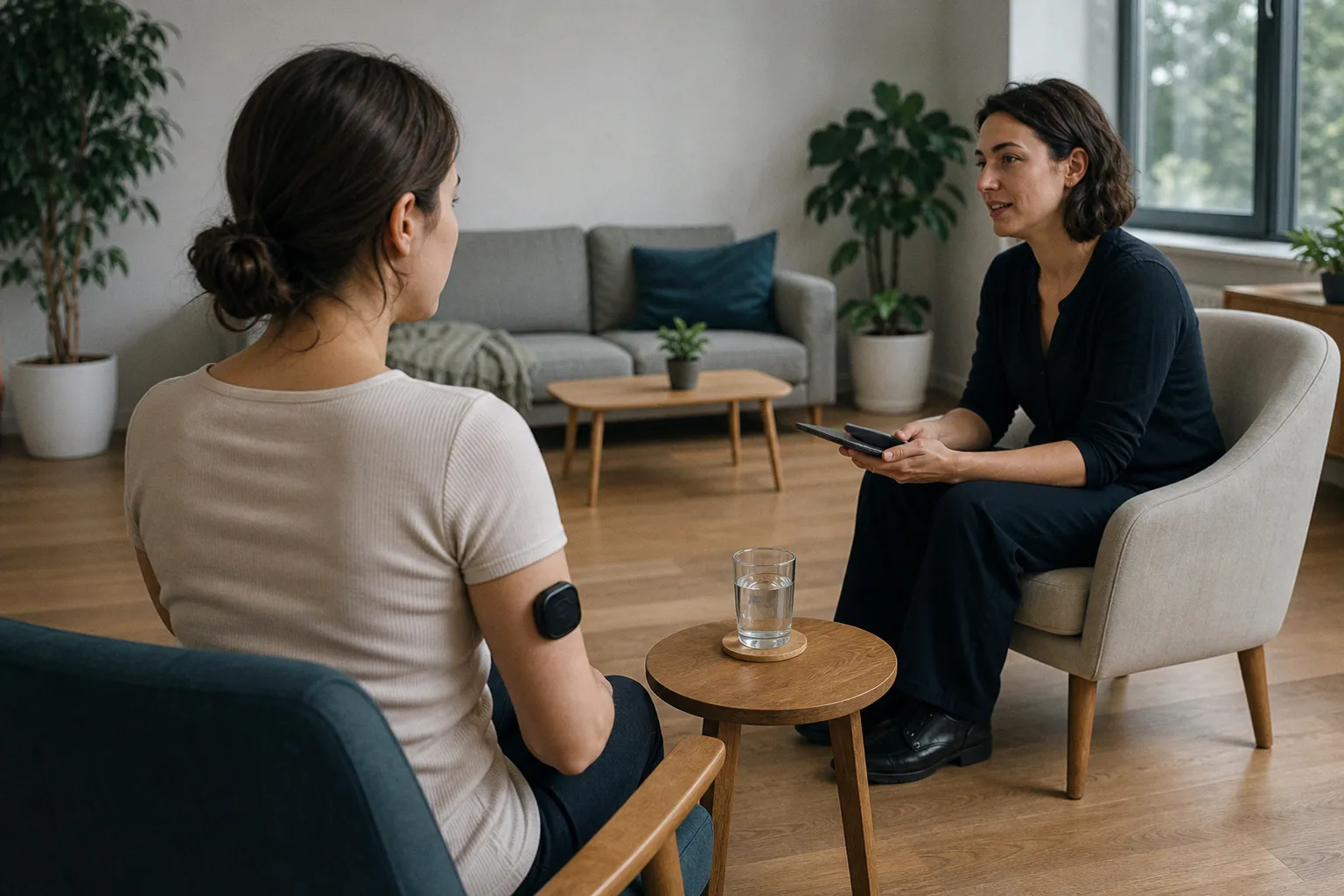
The Mechanism: From Episodic Visits to Continuous Biomarker Streams
Traditional psychiatric care operates on a latency problem. Patients are assessed at intervals of weeks or months, treated with subjective scales, and titrated on medication by retrospective recall. Attunio's stated design inverts that loop: ingest multimodal data between visits, run it through a proprietary intelligence layer, and surface patterns a clinician might miss in a 20-minute session.
The platform aggregates inputs from biomarkers, wearable devices, and remote monitoring to track variables the source identifies as relevant — sleep disruption, glucose instability, nutrient deficiencies, chronic stress signatures, inflammation markers, and medication metabolism differences. AI surfaces correlations and early warning signals. A human clinician then interprets the output and adjusts the protocol. That division of labor — machine pattern recognition, human clinical judgment — is the only architecture worth taking seriously in this category.
What "Closed-Loop" Actually Means Here
The term is borrowed from control theory: a system that measures its output, compares it to a target, and corrects in real time. In Attunio's formulation, that translates to continuous data ingestion, dynamic monitoring of patient progress rather than episodic check-ins, and treatment plan adjustments driven by measurable changes in physiology and behavior, not symptom self-report.
The hard question is signal fidelity. Closed-loop only outperforms standard care if the biomarkers are valid, the wearable sampling rate is high enough to detect clinically meaningful variance, and the AI model's predictive validity has been tested outside the training set. The announcement does not disclose any of these parameters.
What to Verify Before Enrolling
- Specific biomarker panel. Which assays, which reference ranges, which turnaround time. Vague "advanced biomarker testing" is not a protocol.
- Wearable specifications. Sampling frequency for HRV, glucose monitoring method (CGM vs. intermittent), sleep staging accuracy.
- Clinician credentials. Licensing, specialty, caseload, and whether the same clinician sees the data stream or whether interpretation is pooled.
- Outcome data. Any published or pre-registered metrics on treatment response, medication adjustment speed, or relapse detection versus standard care. Without that, this is a hypothesis, not a result.
- Data ownership and exit terms. Who holds the continuous physiological record, and can the patient export the full dataset.
- Cost structure. Subscription, insurance billing, out-of-pocket ranges, and what the discontinuation pathway looks like.
The macro trend behind the launch is real: rising ADHD and anxiety diagnoses, growing wearable adoption, and clinician demand for objective data. Whether Attunio converts that trend into measurable cognitive outcomes depends entirely on the engineering underneath the press release. Treat the architecture as plausible, the claims as pending verification, and your own dopaminergic baseline and HRV trends as the only metrics that matter on day one.