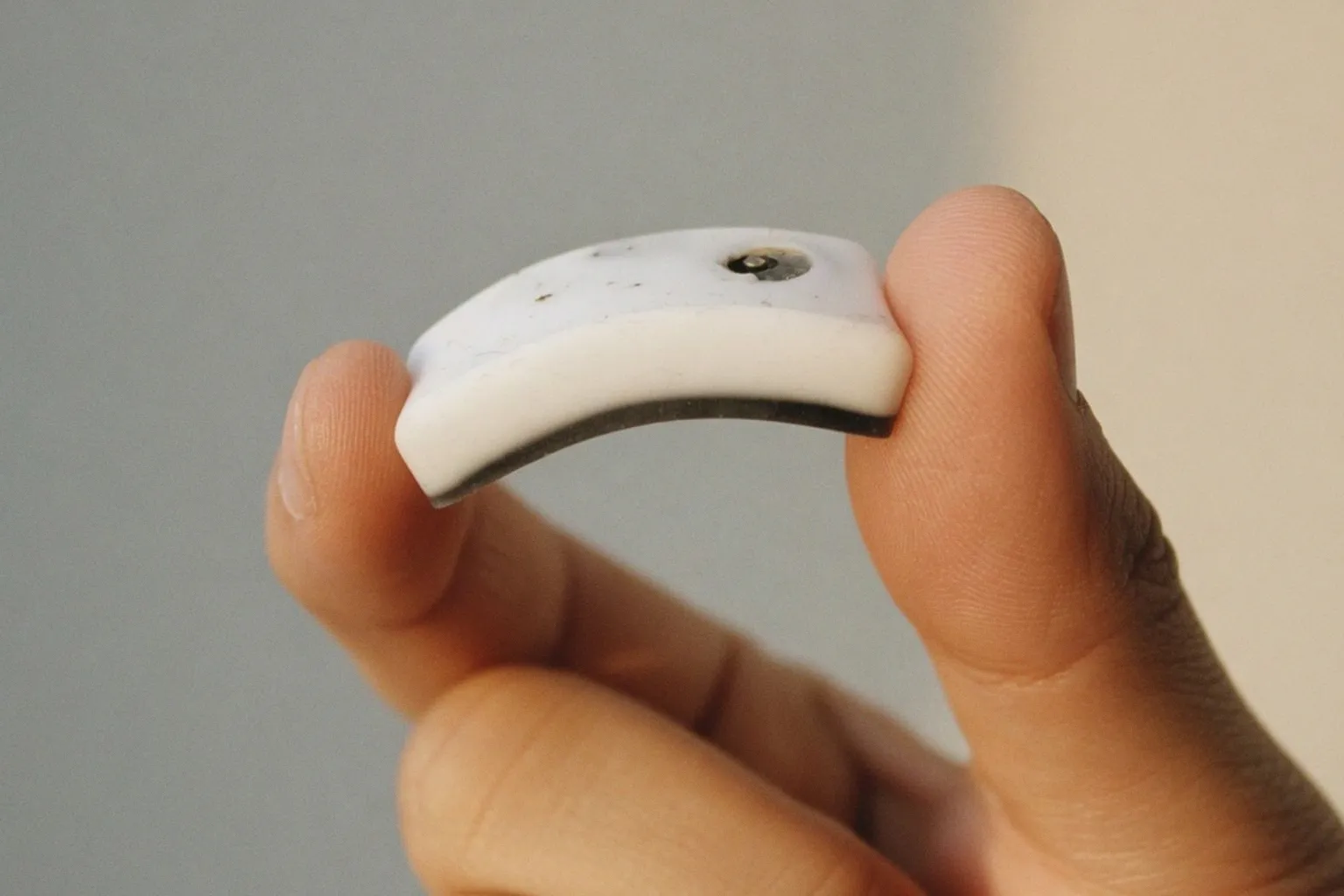
Good sleep is not a wellness accessory; it is a cognitive maintenance window. Newswise reports that Georgia Tech researchers have developed a soft, wireless wearable device intended to support at-home monitoring of physiological changes associated with sleep and brain health. The relevant shift is not consumer convenience. It is the possibility of collecting sleep-related brain-adjacent signals outside the artificial latency, pressure, and cost structure of the clinic.
The signal: useful, but not yet clean
The device described in the report uses near-infrared spectroscopy: LED light at specific wavelengths is emitted toward tissue, reflected signals are captured by a photodetector on the skin, and the data are transmitted wirelessly via Bluetooth to a nearby device for analysis.
The target domain is not generic sleep staging. The research team is looking at brain water dynamics and glymphatic clearance-related patterns during sleep and rest. That matters because the glymphatic system is involved in clearing metabolic waste that accumulates during waking hours. The source links this activity to memory processing, cognitive function, and neural recovery.
This is the important boundary: the wearable is not presented as a magic proxy for cognition. The researchers explicitly note that the optical signal can be affected by non-brain variables:
- breathing depth;
- small changes in forehead pressure;
- body position;
- motion;
- temperature drift;
- skin, scalp, device pressure, or movement.
That is the right skepticism. A soft sensor on the forehead is still measuring through a biological and mechanical filter. The team therefore focused on trends over time rather than claiming exact measurements of brain water content.
For cognitive-performance readers, that distinction is not semantic. It separates a plausible research instrument from a premature consumer diagnostic.
Why home sleep data changes the research equation
Traditional brain monitoring methods are described in the report as invasive, costly, and largely confined to clinical settings. MRI and polysomnography can generate valuable data, but they also impose a measurement environment: wires, unfamiliar rooms, time constraints, and sleep that may not resemble a normal night.
The Georgia Tech group’s device is designed to be soft, wireless, non-invasive, and usable in a natural home sleep environment. According to W. Hong Yeo, who led the team, the system is intended to overcome restrictive, costly, and invasive limitations of conventional approaches.
That could matter for neurotechnology because sleep is not a single event. It is a repeated physiological state shaped by environment, behavior, temperature, stress load, and circadian timing. A device that can collect continuous home data may help researchers see temporal patterns that are harder to capture in a lab.
But the constraint remains: more natural data are not automatically more valid data. Home monitoring reduces one form of distortion while introducing others — movement, inconsistent placement, ambient conditions, and user handling. The value will depend on how well those artifacts are modeled, flagged, or excluded.
Patient-facing takeaway: check the evidence layer before the device layer
For anyone considering this category of technology through a clinic, sleep program, or digital-health pathway, the practical question is not “Is it wearable?” The better question is: what is the measurement claim?
Before treating any soft sleep-monitoring wearable as clinically meaningful, ask for the following:
- What physiological variable is being measured directly?
- What is inferred from that signal?
- Which artifacts are known to affect the reading?
- Are outputs reported as absolute values or trends over time?
- Is the device being used for research, screening, monitoring, or diagnosis?
- What data are transmitted over Bluetooth, where are they stored, and who can access them?
The Georgia Tech report is careful on the core scientific point: the device may support future studies of sleep, glymphatic activity, and brain health in real-world settings. That is a measured claim. It should stay measured.
The near-term promise is not an at-home verdict on brain health. It is lower-friction observation of sleep physiology — with enough humility about signal contamination to make the data worth interrogating.