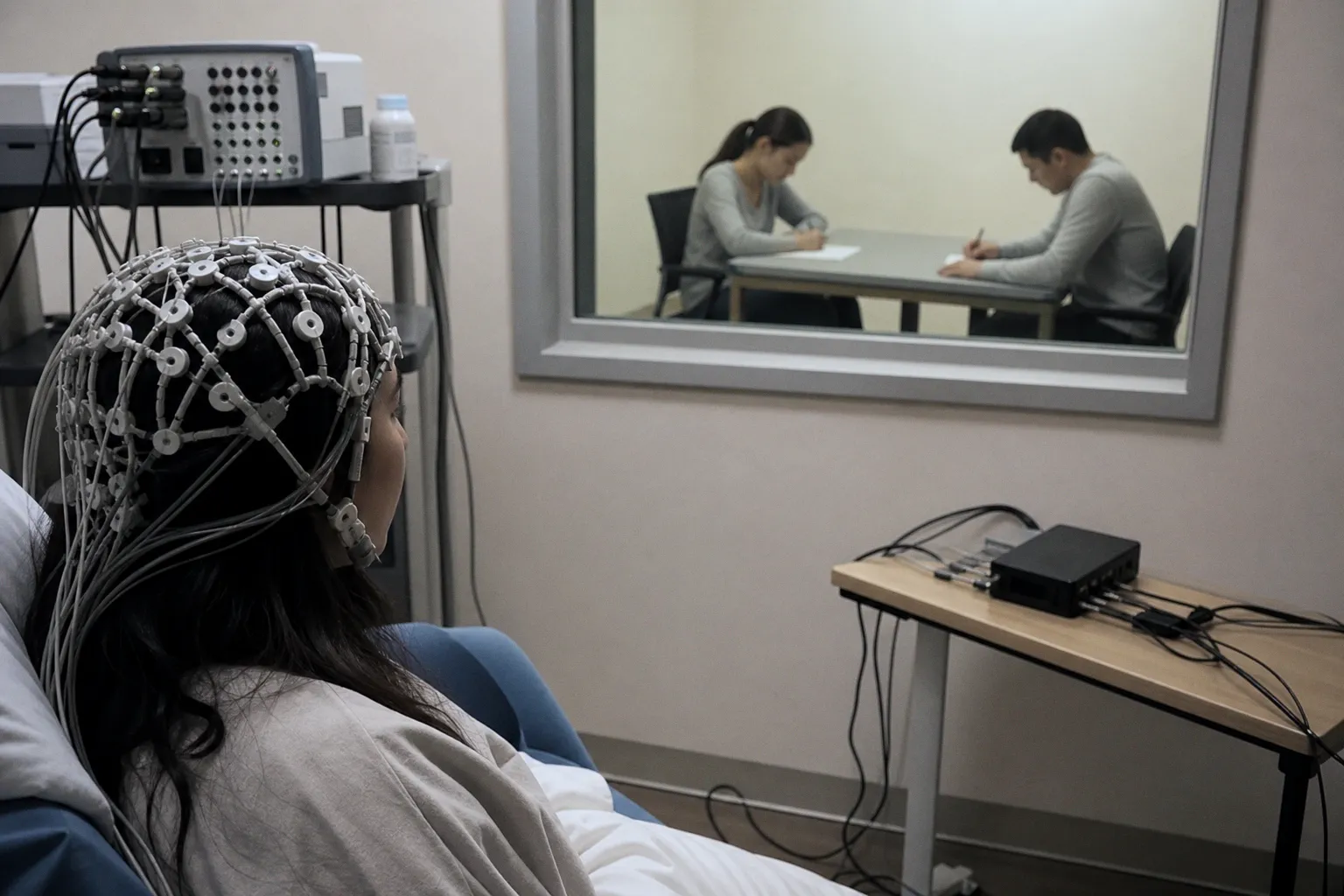
A new meta-analysis published in Frontiers in Sleep pulls polysomnography recordings from across the literature to answer precisely that. The work, led by Diana Campos-Beltrán at the University of Lübeck, isolates one specific micro-event: the sleep spindle.
The Micro-Event in Question
Sleep spindles are bursts of oscillatory activity—lasting anywhere from half a second to three seconds—generated deep within the thalamus and propagated outward through the cortex. They are not background noise. Spindles are tightly coupled to memory consolidation and are treated as a direct electrophysiological proxy for the brain's offline reorganization of newly encoded information.
The Campos-Beltrán group wasn't measuring cognition directly. They were building a normative atlas of how spindles vary across a healthy population. To do it, the team required every contributing study to include both quantitative spindle measurements and full polysomnography—EEG plus electrooculography and electromyography to precisely stage the night.
The Four Variables That Actually Moved
Three demographic dimensions showed clean, statistically tractable effects. The fourth—cognitive ability—appears in the framing but is less resolved in the source narrative than age-related shifts.
The age effects are the most documented:
- Density. Spindle count per unit of non-REM sleep declines steadily with age.
- Amplitude. The electrical height of individual bursts diminishes in older adults.
- Duration. Individual spindle length shortens as age increases.
Layered on top, older subjects spent less time in the deepest slow-wave stages and shorter windows of REM sleep. So the spindle decay is not an isolated phenomenon—it rides on a broader erosion of sleep architecture.
Why a Baseline Atlas Matters Now
The underlying motivation is practical, not academic. Campos-Beltrán notes that the field is actively pursuing gentle electrical or auditory stimulation to enhance slow-wave activity and, by extension, consolidation. Closed-loop auditory stimulation already shows acute effects on spindle amplitude in younger adults.
Population-level baselines are the missing piece. Without a clean reference of how spindles vary by age, sex, and baseline cognition, any stimulation protocol has to guess whether it is augmenting a signal or compensating for one. The meta-analysis is, functionally, the calibration step before intervention science scales.
For anyone tracking the cognitive-performance pipeline, the takeaway is concrete: the next round of sleep-tech efficacy claims will increasingly be measured against this kind of demographic-normalized spindle data, not against single-cohort controls. When you see a "boost your deep sleep" pitch referencing spindle amplitude, the relevant question is no longer whether the number went up—but against which segment of a forty-study, 1,878-subject distribution it moved.